AI Robot Trading: Build Strategies You Can See & Trust
AI robot trading promises to automate your edge — but most platforms either hide their logic behind a black box or bury you in code. This guide cuts through both problems: it explains exactly how automated trading strategies work under the hood, what separates a trustworthy bot from a fraudulent one, and how a visual no-code builder lets you construct, inspect, and validate your own rules before you risk a single dollar.
What AI Robot Trading Actually Is
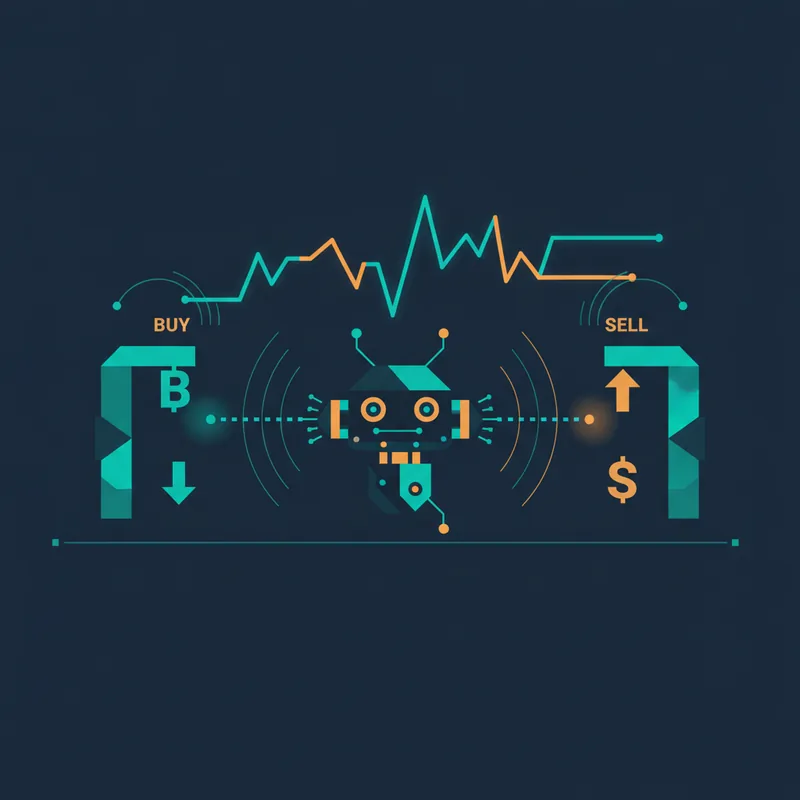
AI robot trading refers to software that monitors markets and executes trades automatically based on predefined logic — no manual clicking required. The term gets used loosely, so it's worth being precise before you commit capital to any system.
Rule-Based Automation vs. True Machine Learning
Most retail bots marketed as "AI" are, in practice, algorithmic trading systems: they follow a fixed set of if/then rules you (or the developer) define in advance. If RSI drops below 30 and price crosses above the 20-period moving average, buy. That's an algorithm, not artificial intelligence in the machine-learning sense.
True machine-learning bots operate differently — they attempt to discover patterns in historical data rather than follow hand-coded rules. In practice, this approach introduces its own complexity and auditability challenges that make it difficult to verify what the system is actually doing.
Why Most Retail "AI" Bots Are Really Algorithmic Bots
The distinction matters because the word "AI" carries an implication of self-improvement and intelligence that most retail products don't deliver. What they do deliver — when built well — is consistent, emotion-free execution of a rule set you define. That's genuinely useful. But calling it AI sets expectations that lead traders to trust a system they don't understand, which is where things go wrong.
For the purposes of this guide, automated trading strategy and AI trading bot are used interchangeably to mean rule-based automation — because that's what you'll encounter in the retail crypto trading market.
How AI Trading Robots Work: The Mechanics Behind the Automation
Understanding the internal mechanics of any bot is the prerequisite for evaluating one honestly.
Reading Market Signals: Indicators and Price Conditions
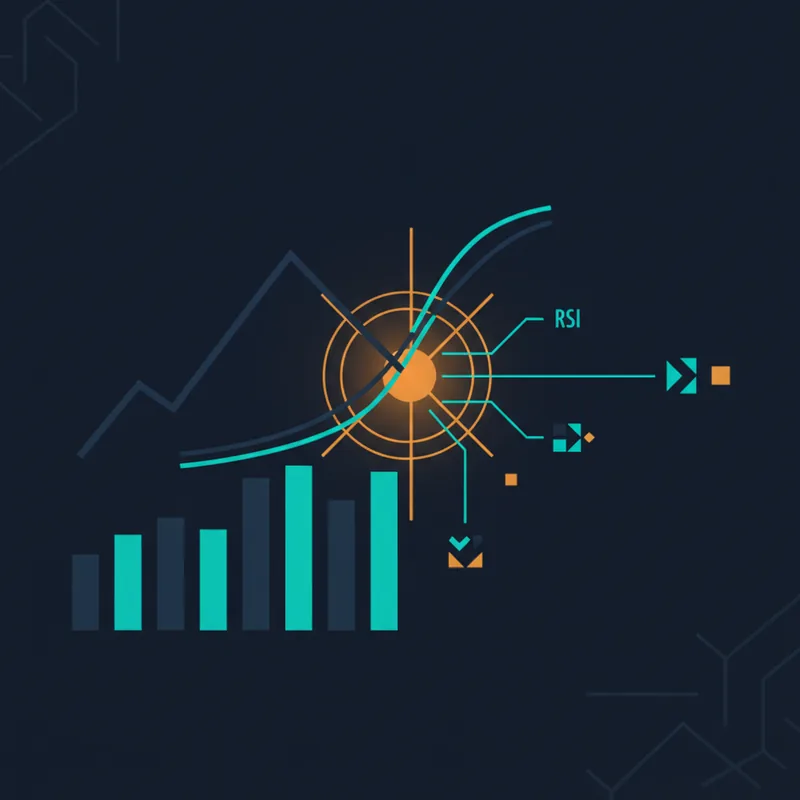
A bot continuously reads market data — price, volume, order book depth — and evaluates it against trading indicators: mathematical calculations applied to price or volume data to surface signals. Common examples include moving averages, RSI (Relative Strength Index), MACD, and Bollinger Bands.
A price crossover (e.g., the 9-period EMA crossing above the 21-period EMA) or a volume signal (e.g., volume spiking relative to a recent average) are typical trigger inputs. The bot checks these conditions on every new candle or tick, depending on configuration.
Triggering Orders: Entry, Averaging, and Exit Logic
When conditions are met, the bot fires an order. The logic chain typically looks like this:
- Entry conditions — the specific combination of signals that opens a position
- Averaging orders — additional buys (in a long strategy) placed at lower prices if the position moves against you, reducing average cost basis
- Exit conditions — the rules that close the position, either at a profit target or a defined loss threshold
- Stop-loss — a hard floor that closes the trade if price falls beyond a set percentage or price level, capping downside
Each of these is a conditional rule. The quality of your strategy lives entirely in how well these rules are defined and how they interact.
Connecting to an Exchange: How Execution Actually Happens
The bot doesn't hold your funds — your exchange does. Exchange integration works through API keys: you generate a key pair on your exchange (Binance, Coinbase, Kraken, etc.), grant the bot permission to trade on your behalf, and the bot sends orders via the exchange's API. The exchange executes them. You retain custody of your assets; the bot only has trading permissions, not withdrawal access — and you should verify that before connecting anything.
The Black-Box Problem: Why You Can't Trust What You Can't See
This is the central risk in AI robot trading, and it's the one most marketing copy glosses over.
Red Flags That Signal a Black-Box or Fraudulent Bot
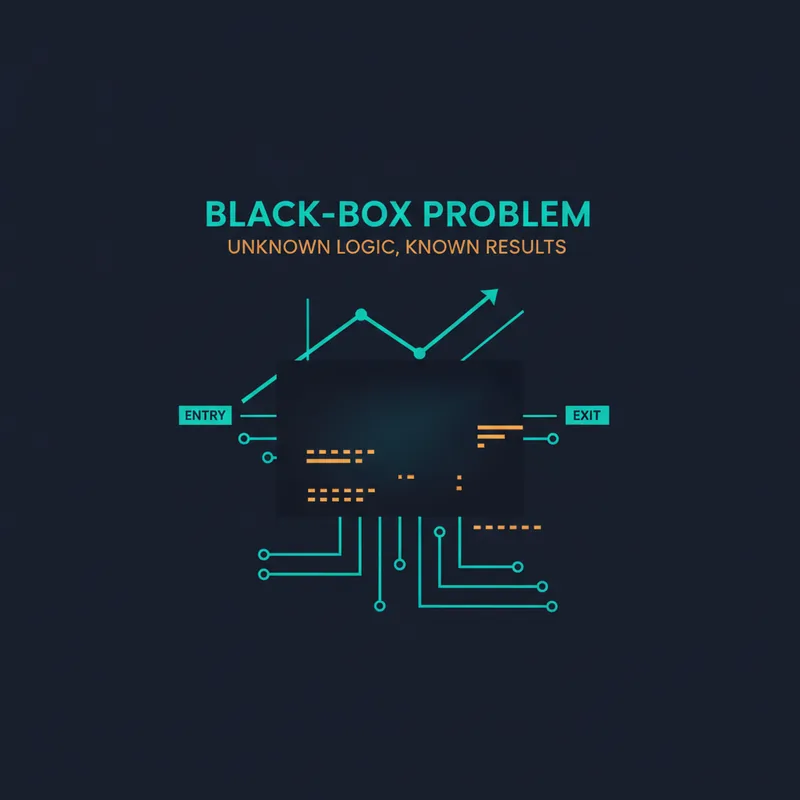
A black-box bot is any system where the trading logic is hidden from you — you see entries and exits on a chart, but you have no visibility into why the bot entered, what conditions triggered it, or how it will behave in a different market regime.
Red flags to watch for:
- Unverifiable backtest results — screenshots of equity curves with no way to reproduce the test or inspect the parameters
- Guaranteed returns — no legitimate trading system can promise consistent profits; the CFTC has issued explicit warnings about AI trading scams that make exactly these claims
- No logic disclosure — the platform can't show you the condition set driving decisions
- Parameter-buried logic — dozens of sliders and settings with no explanation of how they interact, making it impossible to understand what the bot is actually doing
- Pressure to deposit more — a common pattern in fraudulent schemes flagged by regulators
The CFTC (U.S. Commodity Futures Trading Commission) has specifically warned retail traders about AI-branded trading schemes that fabricate performance records and obscure how decisions are made. If you can't audit the logic, you can't distinguish a legitimate strategy from a scam.
What a Transparent Bot Should Show You Before You Go Live
A trustworthy automated trading system should let you:
- See the exact conditions that trigger each entry and exit — not just labels, but the actual logic
- Visualize where those rules fired on historical chart data
- Run a backtest on your own chosen date range with your own parameters
- Inspect individual trades to understand why they opened and closed
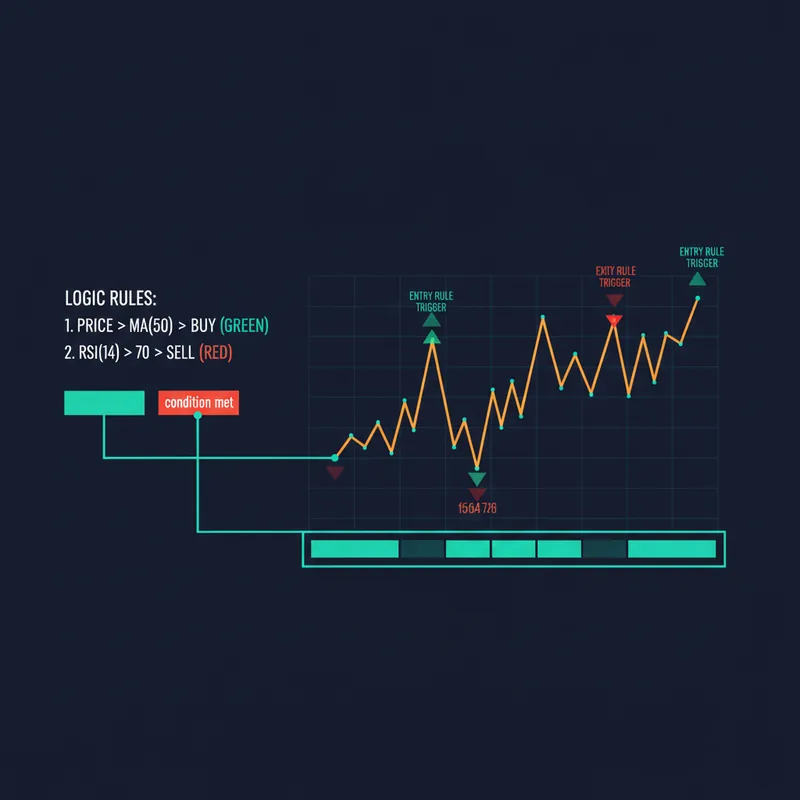
Visual rule display — showing rule triggers directly on the chart — is the clearest form of this transparency. If a platform can't show you where your strategy would have acted on past data, you have no basis for trusting it with live capital.
Can You Make Money with AI Robot Trading? Realistic Expectations
Yes — but the bot is not the edge. Your strategy logic is.
Why Backtesting Is the Only Honest Proof
Backtesting means running your strategy rules against historical market data to see how they would have performed. It's the only way to validate that your logic does what you think it does before you deploy real capital. A strategy that looks intuitive on paper often behaves very differently when applied to actual price history.
A credible backtest gives you a detailed trade-by-trade record — performance metrics, individual entries and exits, and the conditions that triggered each — so you can verify the bot acted on the reasons you intended, not just that the overall result looked good. Any platform that won't let you run your own backtest, or only shows you pre-baked results, is hiding something.
What Backtesting Can and Cannot Tell You
Backtesting is necessary but not sufficient. Its limits are real:
- Overfitting risk — if you tune your parameters too tightly to fit a specific historical period, the strategy is likely to underperform on new data. An unusually high win rate over a narrow backtest window is a common warning sign.
- Market regime change — a strategy that worked in a trending bull market may perform poorly in a ranging or bear market. Test across multiple market conditions.
- Slippage and fees — backtests that don't account for trading fees and execution slippage overstate real-world returns.
The honest answer to "can I make money?" is: it depends entirely on whether your strategy logic has a genuine edge, and backtesting is how you find out — not a guarantee of future results.
How to Build Your Own AI Trading Robot Without Writing Code
Building your own strategy is the most reliable way to know exactly what your bot will do. Here's the workflow using a visual no-code strategy builder.
Step 1: Define Your Entry Logic with Indicators and Conditions
Start with the signal that tells you a trade is worth taking. In a visual condition builder, you select indicators from a library (RSI, EMA, MACD, volume, price levels) and connect them with AND/OR logic to form your entry rule.
Example: RSI(14) < 35 AND price crosses above EMA(20) AND volume > 1.5× 20-period average.
Each condition is a puzzle piece. You connect them visually — no syntax, no brackets, no debugging compiler errors. The condition builder handles nested logic, so you can build genuinely complex rules without writing a line of code.
Step 2: Set Exit Rules, Stop-Losses, and Averaging Orders
Once your entry is defined, set the rules that govern how the position is managed:
- Exit conditions — profit target (e.g., +4% from entry), indicator-based exit (RSI > 70), or time-based close
- Stop-loss rules — fixed percentage below entry, trailing stop, or ATR-based
- Averaging orders — define how many additional buys to place, at what price intervals, and with what size, if the trade moves against you
These rules live in the same visual interface as your entry logic. The deal map — a drag-and-drop canvas that maps the full lifecycle of a trade — shows entry, averaging layers, and exit in a single view.
Step 3: See Your Strategy on the Chart Before It Trades
This is where visual builders earn their value. A visual debugger overlays your strategy's rule triggers directly on the price chart: green markers where entry conditions fired, exit markers where the position closed, and highlighted zones where averaging orders would have placed. You can scroll through months of history and see exactly how your logic behaved — before a single order is sent.
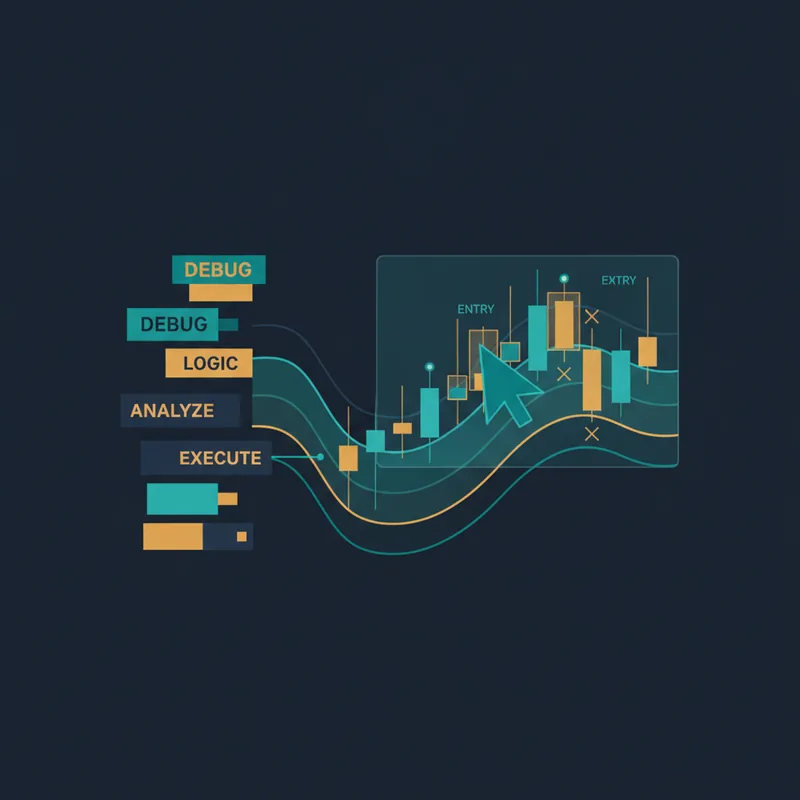
This step alone eliminates the black-box problem. If the chart shows entries in places that don't match your intent, you fix the logic before it costs you.
Step 4: Backtest and Validate — Then Launch
Run a backtest across your chosen date range. Review the trade log, not just the equity curve. Check individual trades: did the bot enter and exit for the reasons you intended? Adjust, re-test, and iterate until the behavior matches your strategy thesis.
When the logic holds up across different market conditions, connect your exchange via API and launch. Quberas follows this exact workflow — build, visualize, backtest, launch — keeping every step in one interface so you never lose sight of what the bot is doing or why.
No-Code Visual Builders vs. Black-Box AI Bots: A Practical Comparison
Evaluation Criteria: What to Compare Before You Commit
| Criterion | Black-Box AI Bot | No-Code Visual Builder |
|---|---|---|
| Logic transparency | Hidden | Fully visible |
| Customizability | Low — preset strategies | High — define your own rules |
| Backtesting quality | Often pre-baked or unverifiable | Run your own, inspect trade-by-trade |
| Exchange integration | Varies | Typically broad API support |
| Ease of use for non-coders | High (but opaque) | High (and transparent) |
| Cost / free tier | Varies widely | Varies by platform |
Platforms like Cryptohopper and Coinrule sit in a middle category — they offer template-based strategies and some condition customization, but the depth of logic visibility and backtest control varies by plan and platform design. They're worth evaluating, but apply the same transparency criteria above.
When a Black-Box Bot Might Be Acceptable — and When It Isn't
A black-box approach might be acceptable if: you're allocating a small, fixed amount you're genuinely prepared to lose, the platform has a verifiable live track record (not just backtests), and you understand you're essentially delegating all strategy decisions.
It's not acceptable when: you're deploying significant capital, you want to understand and improve your strategy over time, or you're evaluating a platform that makes performance guarantees. In those cases, opacity is a dealbreaker.
How to Choose the Right AI Trading Robot for Your Strategy
Use this checklist before committing to any platform:
- Exchange integration compatibility — does it support your exchange, and does it use read-only vs. full trading API permissions?
- Strategy transparency / logic visibility — can you see the exact conditions driving every trade?
- Backtesting availability — can you run your own test on custom date ranges, or are you shown pre-built results?
- No-code vs. code requirements — if you don't write code, verify the visual interface covers the complexity you need
- Crypto trading asset support — does it cover the pairs and markets you trade?
- Cost structure and free tier — what's available before you pay, and what are the live-trading fees or subscription costs? Check what's actually restricted before assuming full functionality.
- Customer support and documentation — is there a clear knowledge base and responsive support for when something behaves unexpectedly?
No platform is perfect on all dimensions. Prioritize transparency and backtesting quality above everything else — those two criteria determine whether you can actually trust and improve what you're running.
Frequently Asked Questions About AI Robot Trading
How Do I Get Started with an AI Trading Robot?
Choose a platform that supports your exchange, create an account, and define your strategy logic — either by selecting a template or building your own conditions. Connect your exchange via API keys (trading permission only, not withdrawal), run a backtest, and deploy with a small position size while you monitor live behavior. Don't skip the backtest step.
Is AI Robot Trading Safe?
The technology itself is neutral — the risk comes from the strategy logic and the platform you trust. A transparent platform where you can audit every rule is significantly safer than a black-box system. Never connect a bot with withdrawal permissions, never deposit more than you can afford to lose, and treat any platform promising guaranteed returns as a scam.
Are There Free AI Trading Robots?
Some platforms offer free tiers, though what's included varies significantly. Before assuming you can test a platform's full feature set at no cost, check specifically which capabilities — number of active bots, backtest access, or strategy complexity — are available on the free plan versus locked behind a paid tier.
Do I Need to Know How to Code?
Not if you use a no-code visual builder. Platforms built around drag-and-drop condition logic and visual deal maps let you construct complex, nested trading rules — price crossovers, volume signals, multi-condition entries — without writing a single line of code. The constraint is that you still need to understand trading logic; the tool removes the programming barrier, not the strategy-thinking requirement.
Try building your first AI trading strategy on Quberas — no code required. See your rules trigger live on the chart, backtest before you risk capital, and launch when you're confident in the logic.