AI Stock Trading App: How to Pick One You Trust
What Is an AI Stock Trading App?
An AI stock trading app is any software that uses machine learning or rule-based automation to analyze market data and either recommend, execute, or help you build trades — instead of you scanning charts and pulling the trigger manually. The category sounds like one thing, but it actually splits into distinct product types, and confusing them is the main reason traders end up disappointed.
AI stock picks are the simplest form: the app scores or ranks stocks (or crypto assets) based on patterns in price, volume, fundamentals, or sentiment data, and hands you a list — buy, hold, avoid — without necessarily explaining the reasoning in a way you can independently verify. An AI investing copilot goes a step further: it's a conversational or dashboard-based assistant, often built on large language models, that can be connected to live market feeds, historical data, and even trade execution infrastructure, letting you ask questions and get answers framed as guidance rather than a fixed signal. An AI trading bot, by contrast, actually places trades — either following a model's live output or executing pre-defined rules once conditions are met.
Tools that were once reserved for hedge funds and institutional desks — pattern recognition, automated execution, portfolio-level risk scoring — are now packaged into retail-facing apps that anyone can subscribe to. That accessibility is genuinely useful, but it also means the label "AI stock trading app" now covers everything from a black-box scoring engine to a fully transparent, no-code strategy builder where you define every condition yourself — which is the category Quberas sits in, precisely because many traders want to see the logic, not just the output, before it touches their capital.
AI stock pickers vs. AI trading bots vs. no-code strategy builders
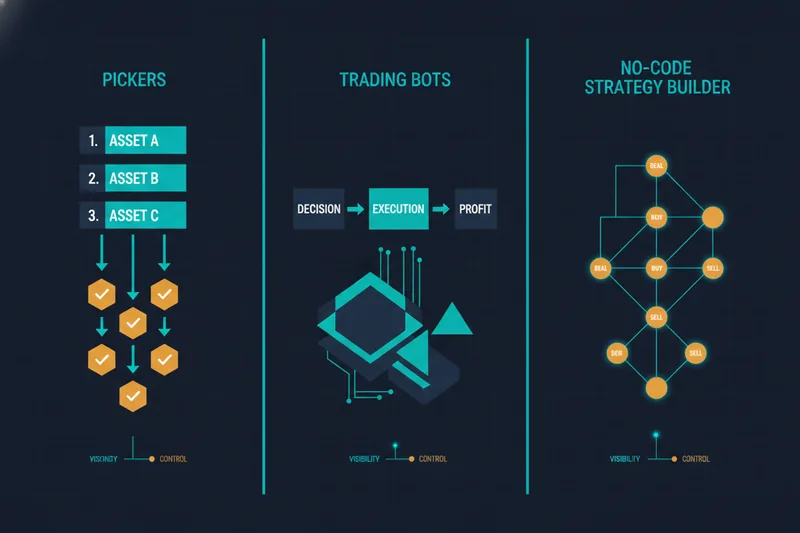
The practical difference comes down to who controls the logic and how visible it is:
- AI stock pickers decide what to buy; you decide whether to act. The model's internal reasoning is usually not exposed.
- AI trading bots decide what to buy and execute it, following either a proprietary model or a strategy someone configured — but the configuration may be buried in parameters rather than visible logic.
- No-code strategy builders flip the emphasis: you define the entry, exit, and risk conditions yourself, visually, and the platform executes and reports back exactly where each rule triggered on the chart.
None of these is universally "better" — they answer different needs, which is why the comparison later in this guide separates them rather than ranking them on one list.
How AI Stock Trading Apps Work Behind the Scenes
Whatever the interface looks like, every credible AI stock trading app rests on the same underlying mechanics, and understanding them is what lets you tell a well-built tool from a marketing wrapper.
Data inputs. The model or rule set needs something to read: price and volume history, technical indicators (moving averages, RSI, MACD, volume spikes), and in more sophisticated setups, order-book depth or bid/ask spread data rather than just end-of-candle prices. The richer and cleaner the input data, the more reliable the resulting signal — garbage in, garbage out applies here as much as anywhere.
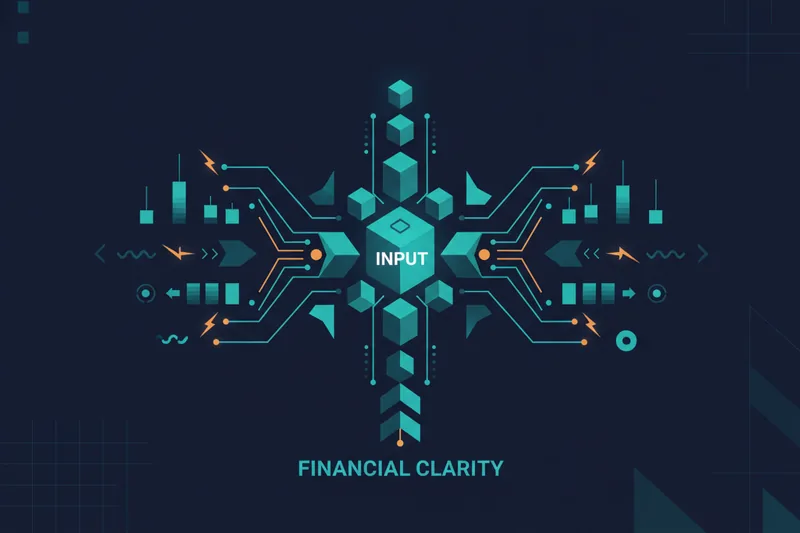
Signal generation. This is where the app turns data into an actual buy, sell, or hold decision — either a trained model scoring probability of favorable movement, or a rule engine checking whether a defined condition (e.g., "RSI crosses below 30 while volume is above its 20-period average") has been met.
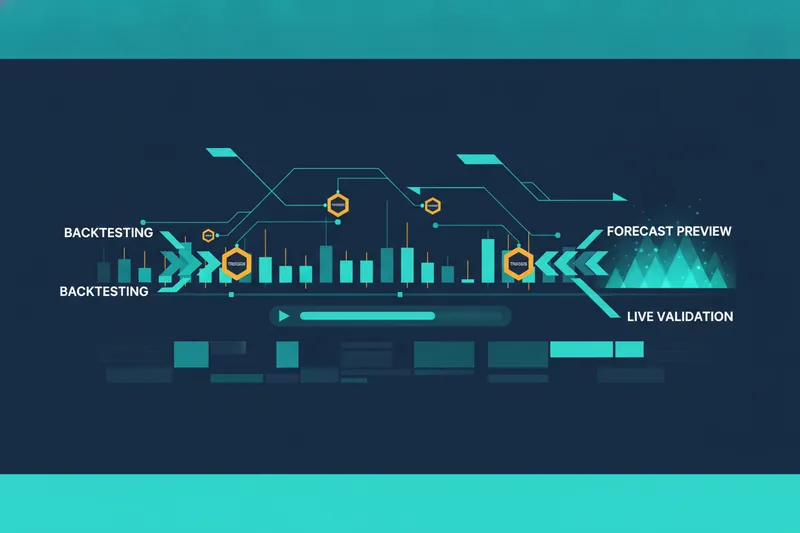
Backtesting is the process of running that signal-generation logic against historical market data to see how it would have performed before you risk real money on it. It's not optional polish — backtesting and forward testing (running the strategy live on a demo or small-scale basis) are both required steps before a strategy should be trusted with real capital; neither substitutes for the other.
Portfolio optimization covers how the app balances risk and return across multiple positions rather than judging one trade in isolation — sizing positions, weighting assets, and evaluating results with metrics like the Sharpe ratio, which measures return relative to volatility. As a rough benchmark, a Sharpe ratio above 1.0 is considered acceptable, above 2.0 very good, and above 3.0 excellent — useful context when an app claims its strategy "performs well."
Risk management is the layer that caps damage: stop-losses, maximum risk per trade, and maximum exposure across open positions. A commonly cited framework, the 3-5-7 rule, sets 3% as the maximum risk on any single trade, 5% as the cap across all open positions combined, and 7% as the minimum acceptable profit-to-loss ratio — a useful sanity check regardless of which app you use. Some strategies also rely on averaging into a position rather than sizing it all at once; dollar-cost averaging (DCA) means splitting a position into fixed purchases made at regular intervals, so the average entry price smooths out over time instead of depending on one timing decision — a mechanic worth understanding on its own terms before assuming every "averaging" feature in an app works the same way.
Black-Box AI Picks vs. Transparent, Rules-Based Automation
This is the fork that matters most once you've decided you want AI involved in your trading: do you want the app to hand you a decision, or do you want to see — and control — exactly why a decision was made?
Black-box AI picks are convenient but opaque. The app tells you a stock scored well or that its model favors a long position, but you generally can't inspect the exact combination of conditions that produced that score, and you can't test a variation of the logic yourself. If the model underperforms in a market regime it wasn't trained for, you often won't know until after the fact.
Rules-based automation takes the opposite approach: you define the conditions — price crosses a moving average, an indicator confirms momentum, volume clears a threshold — and the platform shows you precisely where those conditions were met historically and live. Not all rules-based tools are no-code, either; some platforms let you build and backtest automated strategies but require writing the logic in code such as Python, which reintroduces a technical barrier for traders who aren't programmers.
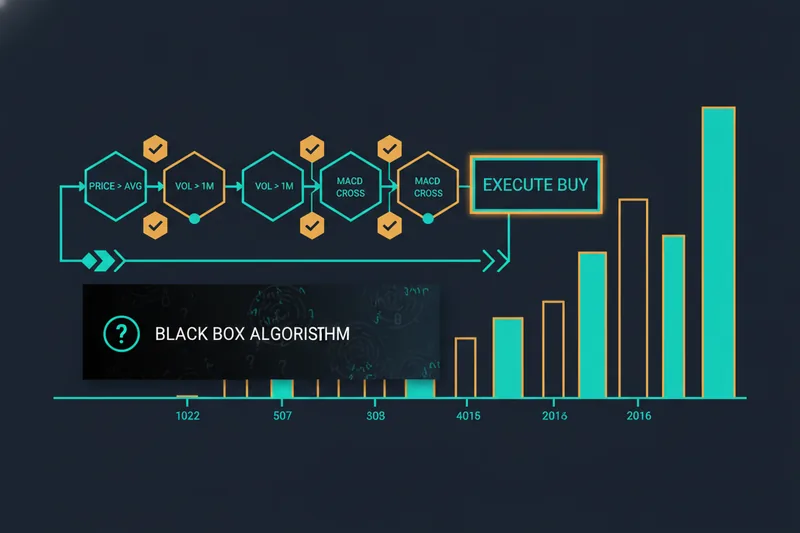
So, do AI trading apps really work? The honest answer is: the signal-generation math can be sound, but "works" only means something once it's been backtested and forward-tested against real conditions — a claim of a good win rate is meaningless without that verification. And is there an AI that can trade stocks fully automatically? Yes — bots can execute without manual intervention — but automatic doesn't mean unsupervised; the safer version of full automation is one where you can pause the bot, inspect why a trade fired, and adjust the threshold, rather than one that's a sealed box. This is what a visual debugger is for: a chart overlay that highlights the exact zone where a condition triggered — or came close to triggering — so you can tell noise from a genuine signal before you commit capital.
Best AI Stock Trading Apps Compared
AI stock-picking and copilot apps
- Danelfin scores stocks using an AI-driven rating system, giving traders a ranked shortlist rather than a rule set they can edit.
- Trade Ideas scans the market and surfaces AI-generated trade ideas and alerts, positioning itself as a research and idea-generation copilot rather than a strategy builder.
- StockHero offers bot-driven automation focused on crypto markets, with pre-configured strategy templates traders can select and customize rather than assemble entirely from scratch.
- Tickeron leans on pattern-recognition "robots" that flag technical setups and, in some products, automate execution around them.
Each of these is useful if your goal is to receive a decision rather than build one — the trade-off is limited visibility into exactly why a given pick or signal fired, and limited ability to test a tweaked version of the logic yourself.
No-code, transparent strategy builders
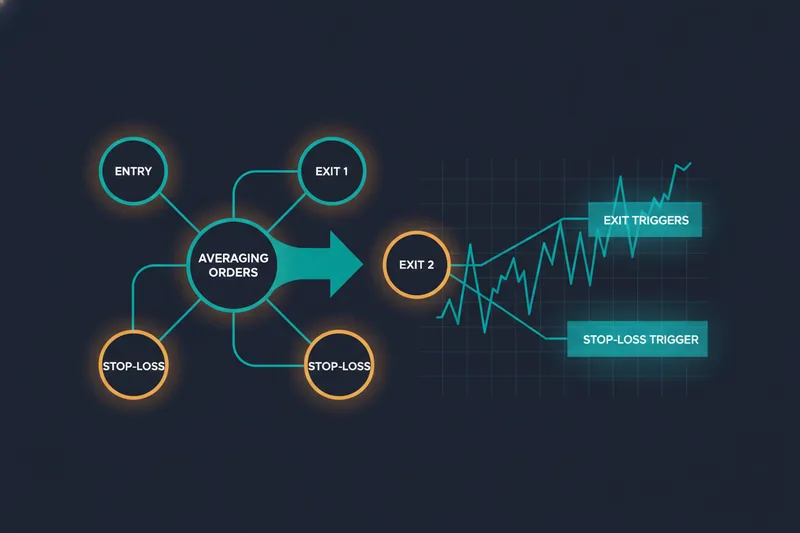
Quberas sits in the second category: a no-code platform where you build a strategy as a visual deal map — connecting entry conditions, averaging orders, exits, and stop-losses as stages rather than parameters buried in a settings panel. Conditions are assembled through a puzzle-style builder that supports nested logic across price, indicators, volume, and crossovers, and the visual debugger highlights the chart zone tied to each condition so you can see whether a rule triggered, almost triggered, or never came close. Strategies are backtested on historical data before being launched live, and traders who don't want to start from a blank canvas can select an existing strategy from the marketplace and adjust its risk parameters instead.
How Much Do AI Stock Trading Apps Cost?
Pricing across the category tends to follow two different models, and the model tells you a lot about what you're actually paying for. Black-box pickers and copy-style services often charge either a flat subscription for access to signals, or a performance-based cut — in copy trading specifically, lead traders commonly take 10–20% of the net profits their followers earn, which means your cost scales with your success but you're still paying for someone else's fixed logic. No-code, transparent builders tend to price around usage and features instead — how many concurrent strategies you can run, how deep your backtesting history goes, and whether you can publish or monetize your own strategies.
The trade-off worth weighing isn't just the sticker price, it's what you're buying with it: a fixed algorithm costs the same whether it fits your risk tolerance or not, while a customizable no-code platform costs you the same effort regardless of complexity, but gives you a strategy you can actually adjust when market conditions shift — rather than waiting for a vendor to retrain a model.
How to Choose the Right AI Stock Trading App for You
There's no single "best" AI for trading — the right answer depends on how much control you want over the decision-making, not just on which app has the highest headline win rate.
If you want ready-made stock picks
If you don't want to define logic yourself, an AI stock-picker or investing copilot is the more direct fit — you're trading control for convenience. The main thing to check before paying for one: does it disclose enough of its methodology (data used, rebalancing frequency, historical performance period) that you can judge whether its edge is real, or are you simply trusting a score?
If you want to build and verify your own logic
If you've been burned by a recommendation you couldn't explain after the fact, weigh these four criteria against each candidate platform: transparency (can you see exactly which condition fired, and when it almost did but didn't?), backtesting depth (does it test against real historical data over a meaningful period, not just a cherry-picked window?), cost structure (flat fee vs. performance cut vs. usage-based), and control (can you edit the logic yourself, or are you stuck with what the vendor shipped?). A no-code builder scores highest on transparency and control by design, since the strategy is yours from the first condition.
Get Started with a Transparent AI-Assisted Strategy
If you've decided you want to see the logic rather than just receive a pick, the next step is to test that logic against history before it touches live capital. In Quberas, that means laying out your entries, averaging orders, exits, and stop-losses on a visual deal map, refining each condition with the puzzle-style builder, and running it through backtesting to see how it would have performed — with the visual debugger showing you exactly where, on the actual chart, each rule would have fired. See exactly how an AI-assisted strategy would have triggered on historical data — build and backtest your own rules visually with Quberas before risking real capital.