VIX Futures Explained: Trading Guide | Quberas
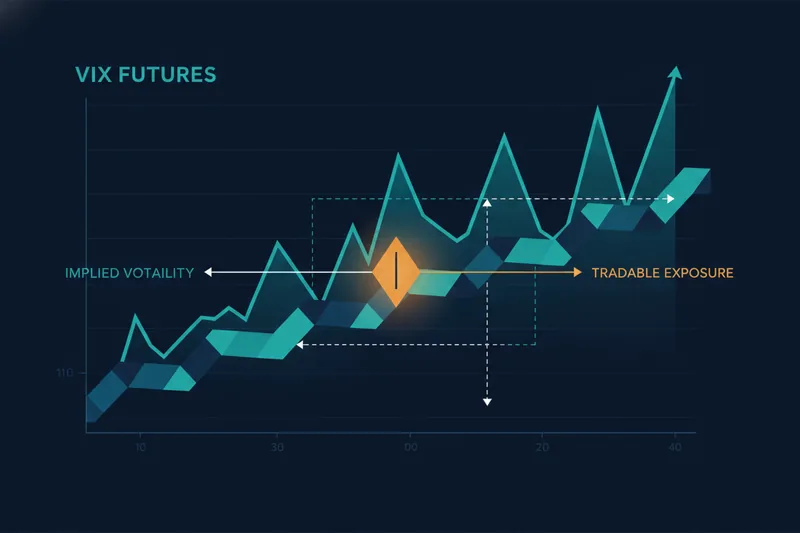
The CBOE Volatility Index (VIX) measures how much price movement the options market expects in the S&P 500 over the next 30 days — and VIX futures are contracts that let you take a position on where that expected volatility is headed, without touching a single S&P 500 option yourself. They settle in cash rather than any underlying asset, they're priced off the market's forward-looking volatility expectations rather than a spot price you can simply look up, and their value moves on a term structure that behaves differently from almost anything else you've traded. This guide walks through how VIX futures are built, priced, and settled, what the futures curve tells you, how they compare to VIX ETFs, and — once the mechanics are clear — how to turn a volatility view into a rule you can actually test before risking money on it.
What Are VIX Futures?
The VIX Index, nicknamed the "fear gauge," is calculated by the CBOE (Chicago Board Options Exchange) from a wide strip of S&P 500 index options prices. It doesn't measure past price swings — it distills the implied volatility embedded in those options, which reflects how much movement traders are collectively pricing in for the next month. When the index reads 15, the options market is pricing in a fairly calm month; when it spikes to 30 or higher, options buyers are paying up for protection because they expect turbulence.
A futures contract is simply a standardized agreement to buy or sell something at a set price on a set future date. But the VIX Index itself isn't a tradable asset — you can't buy "the VIX" the way you buy a stock. VIX futures solve that by letting traders take a position on what the index will be worth at a future expiration date, and because there's no physical VIX to deliver, every contract is cash-settled: at expiration, the difference between the contract price and the final settlement value is simply paid in cash, no shares or index baskets change hands.
That distinction — a derivative built entirely on an expectation, with no underlying you can hold — is exactly why VIX futures confuse people who are used to trading stocks or even standard commodity futures. It's also why turning a VIX view into a defined trading rule benefits from actually seeing the logic rather than working from a spec sheet: platforms like Quberas let a trader map out a VIX-based condition visually and watch where it would have triggered on historical charts, instead of just reading about the mechanics in the abstract.
How VIX Futures Are Priced and Settled
Because the VIX Index reflects 30-day implied volatility from S&P 500 options, and because that implied volatility figure changes constantly as options prices move, VIX futures aren't priced off "today's VIX" — they're priced off where the market expects the VIX to be at that specific contract's expiration. A futures contract expiring in four months isn't a bet on today's fear level; it's a bet on the market's forward-looking volatility expectation for that future date, which is why a near-term contract and a far-term contract can trade at noticeably different levels even though they're both nominally "VIX."
Each VIX futures contract has a defined expiration date, typically falling on a Wednesday roughly 30 days before the corresponding S&P 500 options expiration, since that spacing lets the settlement value be calculated from a fresh strip of options with close to 30 days of remaining life — mirroring how the index itself is built. At expiration, the contract is cash-settled against a special calculation of the VIX, and the position closes automatically; there's no assignment process to manage the way there can be with equity options.
VIX Futures Contract Specifications
Before placing an order, it helps to know the shape of the contract you're trading. VIX futures trade on the CBOE Futures Exchange (CFE) under standardized specifications: a defined contract multiplier applied to the index level, a minimum price increment (tick size) that determines the smallest dollar move you can be quoted, and a monthly expiration cycle that typically lists several near-term and longer-dated contracts simultaneously. Exact multiplier, tick value, and margin figures are set and periodically adjusted by the exchange, so rather than trade off a number that may be outdated by the time you read it, pull the current contract specification sheet directly from the CBOE before sizing a position.
What matters conceptually is this: because the contract is cash-settled and priced off a volatility expectation rather than a stock price, small moves in the underlying VIX calculation can translate into outsized dollar swings per contract given the multiplier — which is part of why position sizing deserves more care here than with a typical equity trade.
Understanding the VIX Futures Curve: Contango vs Backwardation
Plot the prices of all listed VIX futures contracts by expiration date and you get the futures curve (also called the term structure) — a snapshot of what the market expects volatility to look like at each point in the future. This curve isn't static; it shifts shape depending on market conditions, and its shape has real consequences for anyone holding a position over time.
Most of the time, the curve slopes upward: near-term contracts trade cheaper than longer-dated ones. This is contango, and it reflects a market that's calm right now but prices in some uncertainty further out. In contango, a long futures position tends to lose value as time passes and the contract "rolls down" the curve toward the lower near-term price, even if the VIX Index itself hasn't moved.
The opposite condition is backwardation — near-term contracts trading above longer-dated ones. This typically shows up during acute market stress, when traders are paying up for near-term protection because volatility is already elevated right now, and the market expects it to subside later. Backwardation flips the holding-cost dynamic: a long futures position benefits from the roll instead of being penalized by it. Recognizing which regime you're in matters more for VIX futures than for almost any other futures market, because the curve shape directly affects whether simply holding a position works for or against you.
How to Trade VIX Futures
Trading VIX futures directly requires a brokerage account approved for futures trading, since VIX futures are exchange-listed derivatives rather than a stock or ETF you can buy through a standard equities account. Margin requirements apply, as with any futures contract — you post a fraction of the notional value rather than paying in full, which amplifies both gains and losses relative to the capital committed, so check your specific broker's current margin schedule before sizing a trade.
Directionally, traders use VIX futures to speculate on rising or falling volatility: going long if you expect equity markets to become more turbulent, or short if you expect calm to persist. Because the contract is forward-looking, the trade is really a bet on where volatility expectations for that specific expiration will land, not a bet on the VIX print you see quoted right now. VIX futures are also used defensively — as a hedge against a broader equity portfolio, since the VIX tends to rise sharply when the S&P 500 sells off, meaning a long VIX futures position can offset losses elsewhere in a drawdown.
VIX Futures vs VIX ETFs/ETNs (VXX, VIXY, UVXY)
For traders who don't have futures-approved accounts, or who want exposure without managing margin and expiration dates directly, exchange-traded products built on VIX futures — such as VIXY, VXX, and UVXY — offer an alternative route. These products hold rolling baskets of VIX futures contracts rather than the index itself, which means they inherit the same term-structure dynamics described above.
That inheritance is the key trade-off. Because these funds must continuously sell expiring near-term contracts and buy new longer-dated ones, they suffer a roll cost in contango markets — repeatedly selling cheap and buying more expensive contracts as the curve slopes upward — which erodes returns over time even if volatility stays flat. This is why VIX ETFs are widely understood to be poor long-term holdings despite being simple to buy. Their advantage is pure accessibility: no futures account, no margin approval, tradable through any standard brokerage or even inside a retirement account, at the cost of that structural drag and, in some cases, added leverage that magnifies daily moves in either direction.
Using VIX Futures to Hedge or Speculate on Volatility
The VIX earned its "fear gauge" nickname because it reliably spikes when equity markets fall sharply — investors rush to buy S&P 500 puts for protection, options premiums jump, and implied volatility follows. That inverse relationship is why a rising VIX is not, on its own, a bullish signal for stocks; it typically accompanies selling pressure, and traders sometimes ask directly whether VIX going up is bullish — the honest answer is that it's a symptom of falling equity prices and rising fear, not a cause of anything bullish.
Two practical use cases follow from that relationship. Portfolio managers and active traders buy VIX futures or related instruments as a hedge, accepting a small ongoing cost in calm markets in exchange for a payoff when equities sell off. Others treat VIX futures purely as a speculative instrument, taking directional positions on whether volatility itself will rise or fall based on macro catalysts, earnings season, or upcoming economic data — independent of holding any equity position at all.
Building and Backtesting VIX-Based Strategies Without Code
Reading about contango, backwardation, and VIX spikes is one thing; encoding those conditions into a rule you can act on consistently is another. This is where the concepts above stop being trivia and start being decision inputs.
Setting VIX-based entry conditions on a chart
A no-code strategy builder lets you translate a VIX-based idea — "enter when the VIX crosses above a threshold" or "reduce exposure when the futures curve flips into backwardation" — into a visual condition without writing a script. On Quberas, this takes the shape of a deal map: a drag-and-drop layout where entry conditions, averaging orders, exits, and stop-losses are laid out as connected stages, so a VIX spike trigger sits alongside your actual position management rather than living in a separate spreadsheet.
Avoiding false signals with a visual debugger
VIX spikes are noisy — a threshold that looks clean on paper often gets clipped by brief, unconfirmed moves that reverse within a bar or two, generating whipsaw trades that erode returns. A visual debugger highlights the exact chart zones tied to each condition and shows how close a rule came to triggering versus when it actually did, which makes it possible to see false-signal risk directly on the chart and tighten thresholds accordingly, rather than guessing at parameter values in isolation.
Backtesting a volatility filter before going live
Once a VIX-based condition is defined, running it against historical price data shows how it would have performed across past volatility regimes — both contango-heavy calm periods and backwardation-driven stress events. Testing a rule against history isn't a nice-to-have step before committing capital; a strategy generally needs to prove itself in backtesting and then hold up in forward, live-market conditions before it's reasonable to trust it with real money. Comparing variations of the same VIX filter side by side is how you find out whether a threshold that looked promising on a chart actually holds up across multiple volatility cycles.
Where to Find Current VIX Futures Data and Prices
VIX futures prices change constantly, and any number printed in an article is stale within days. For live pricing, contract-by-contract curve data, and official specifications, go directly to the CBOE's own futures data pages, which publish real-time and delayed quotes for every listed expiration along with the exchange's current contract specifications. Most futures brokers and charting platforms also stream live VIX futures quotes under the ticker root used by the CFE, so check your broker's own data feed for order-ready pricing rather than relying on a delayed public quote when timing an entry.
FAQ: Common VIX Futures Questions
Is it bullish if VIX goes up? No — a rising VIX reflects rising expected volatility, which typically accompanies equity selling pressure and demand for downside protection. It's a fear signal, not a bullish one, though it can precede a bounce once fear peaks and selling exhausts itself.
What are the predictions for the VIX price? There's no reliable way to forecast a specific VIX level, since it's derived from options pricing that reacts to unpredictable news and macro events in real time. Rather than chasing a price prediction, traders generally build rules around observable conditions — thresholds, curve shape, spikes — and test how those rules would have performed historically.
How are VIX futures different from VIX options? VIX futures are a direct position on the future value of the index, cash-settled at expiration. VIX options are index options — their underlying is the VIX Index itself, not the futures contracts — and they give buyers the right, not the obligation, to take a position at a set strike price. They're European-style and cash-settled the same way futures are, but with an options premium and time decay layered on top of the volatility dynamics already covered here.
Understanding the mechanics is the easy half — the harder part is turning that understanding into a rule you'll actually follow consistently. Open a free Quberas account and turn your VIX outlook into a visual, backtested trading rule before you risk real capital.