Forex Trading Bot: Build & Backtest Without Code
A forex trading bot is a piece of software that watches live price and indicator data on a currency pair and executes buy or sell orders automatically once a defined set of conditions is met, without a trader manually clicking "buy" or "sell." It doesn't guess or "predict" the market on its own — it follows rules a trader (or a strategy's author) has already programmed or configured, whether that's a moving-average crossover, a support/resistance breakout, or a volatility filter. This guide covers how these bots actually work under the hood, whether the free ones circulating on forums are worth the risk, and how to build a bot whose logic you can see and verify before it ever touches real capital.
What Is a Forex Trading Bot?
A forex trading bot is software that automates the process of opening, managing, and closing trades in the foreign exchange market based on preset rules. It's a subset of automated trading — any trading where execution happens without a human pressing the button — and it typically relies on algorithmic trading logic: a defined sequence of if-this-then-that conditions evaluated continuously against market data. Bots trade the usual forex instruments: major pairs like EUR/USD and GBP/USD, and increasingly gold, quoted as XAUUSD, which behaves like a currency pair in most trading platforms even though it tracks a metal.
Forex trading bot vs. Expert Advisor (EA): same thing, different names
If you've researched this on trading forums, you've likely seen the term Expert Advisor (EA) used interchangeably with "forex trading bot." An EA is the name for a forex trading bot built specifically for MetaTrader 4/5, the two platforms most retail forex brokers support, written in MQL4/MQL5, MetaTrader's proprietary coding languages. Outside of MetaTrader, the same underlying concept — rules that open and close trades automatically — is usually just called a forex trading bot, whether it runs as a standalone application or connects to a broker's API directly. The naming difference matters less than a shared drawback: most EAs are distributed as compiled files you can run but not read, so you're trusting the logic inside without being able to inspect it. That's the black-box problem a visual builder like Quberas is designed to remove, by showing every rule and every trigger point directly on the chart instead of hiding it inside a locked file.
How Do Forex Trading Bots Work?
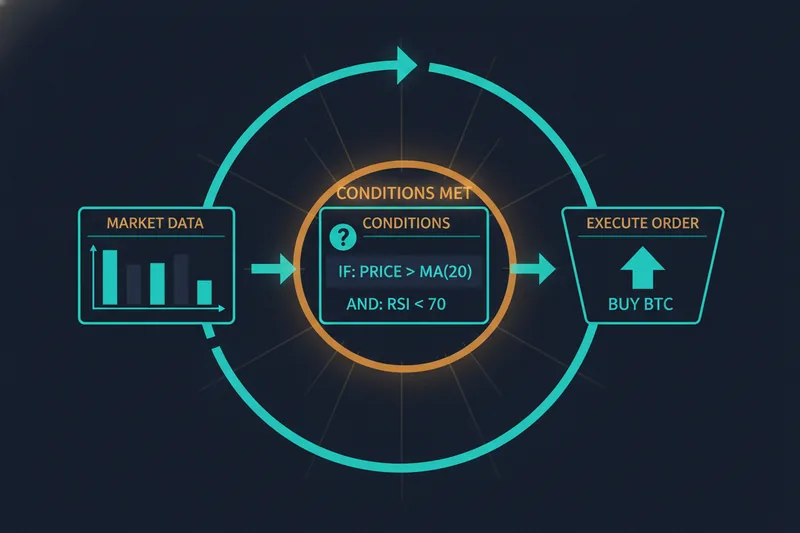
Every bot, regardless of platform, runs on the same basic loop: pull in market data, check it against a set of conditions, and execute an order when those conditions are satisfied. The sophistication lives entirely in how those conditions are defined and how tightly risk is controlled around them.
What triggers a trade: price, indicators, and crossovers
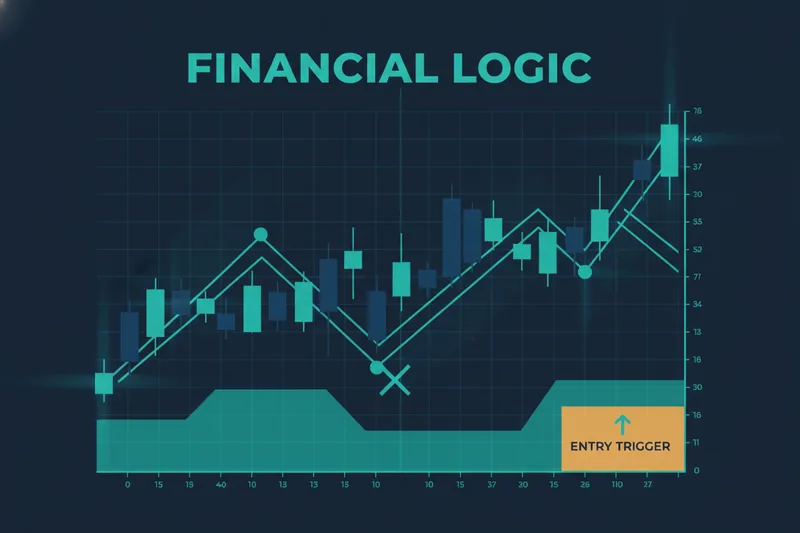
Entry and exit conditions are built from a combination of raw price action, technical indicators (moving averages, RSI, MACD, Bollinger Bands), and volume triggers. A common example: enter long when the 20-period moving average crosses above the 50-period moving average, and RSI is below 70. The bot checks this condition on every new price tick or candle close, and the moment it's true, it sends an order execution instruction to the broker. Crossovers — one line moving above or below another — are among the most widely used trigger types because they're simple to define and easy to visualize.
Where risk rules fit into the logic
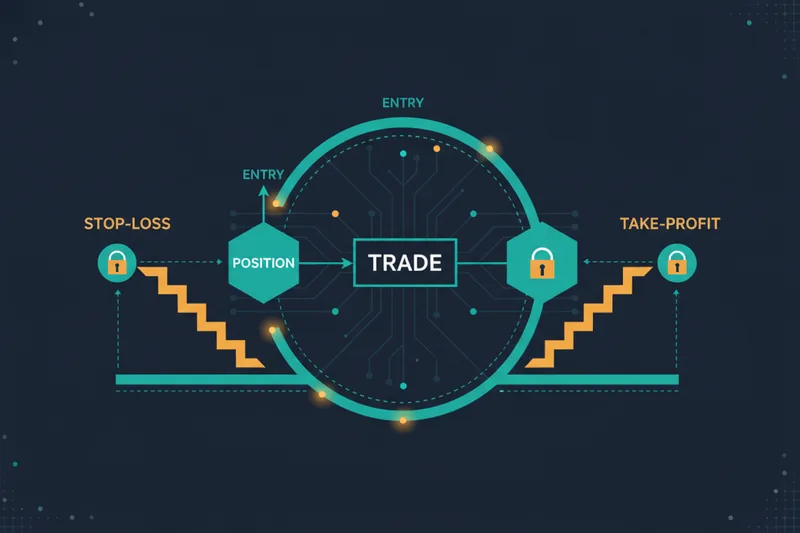
Risk rules aren't an afterthought bolted onto the strategy — they're conditions in the same logical flow as entries. Stop loss levels, take-profit targets, and position sizing are all evaluated the same way entry signals are, just tied to exit rather than entry. A bot without clearly defined risk management rules will hold losing trades exactly as long as its exit logic allows, which is often the real reason a strategy that looked good in testing loses money live.
Do Forex Trading Bots Actually Work? Pros and Cons
Forex trading bots work in the narrow sense that they execute rules faster and more consistently than a human can. Whether they're profitable depends entirely on the quality of the rules and the market conditions they're run in — a bot isn't a shortcut around having a sound strategy.
Pros: consistent execution with no emotional deviation, the ability to run a strategy 24/5 across sessions a human trader would sleep through, and instant application of the same rule set every single time. Cons: a strategy tuned to one market regime (say, trending gold in 2024) can perform poorly the moment volatility or correlation shifts. There's also a well-documented gap between backtested and live performance, driven by spread, slippage, and execution delays that historical data doesn't always capture perfectly.
Why "guaranteed profit" bot claims should raise red flags
Any bot marketed with guaranteed daily returns or "set it and forget it" profits should be treated with skepticism. Forex markets are dependent on macro conditions, central bank policy, and liquidity that no rule set can account for indefinitely. Realistic expectations mean judging a bot on risk-adjusted performance across varied market conditions, not a cherry-picked equity curve from a single bull run.
Free vs. Paid Forex Trading Bots: What You Actually Get
Free forex bots are everywhere — forex forums, GitHub repositories, app store listings promising automated pips with zero investment. The appeal is obvious, but so is the trade-off: cost isn't the only thing you're saving on.
A free EA downloaded from a forum thread usually comes with no support, no update path if a broker changes its API or a market regime shifts, and — critically — no way to verify the logic unless it's shared as open, readable source code, which many aren't. Paid no-code platforms add three things free bots typically lack: ongoing updates as market structure evolves, support when a strategy behaves unexpectedly, and transparency into the actual rules being executed, because the builder itself is visual rather than compiled.
How to vet a free forex bot before risking capital
Before running any free bot, check whether its source or logic is actually inspectable, look for a track record from real users rather than screenshotted backtests, confirm it's still maintained (an abandoned EA won't adapt to platform or broker changes), and test it on a demo account first, regardless of what its author claims about performance.
How to Build Your Own Forex Trading Bot Without Coding
The alternative to trusting someone else's black box, free or paid, is building your own logic and being able to see exactly what it does. A no-code strategy builder lets you define entry conditions, risk rules, and exits through a visual interface instead of writing MQL or Python.
Mapping entries, averaging orders, exits, and stop-losses visually
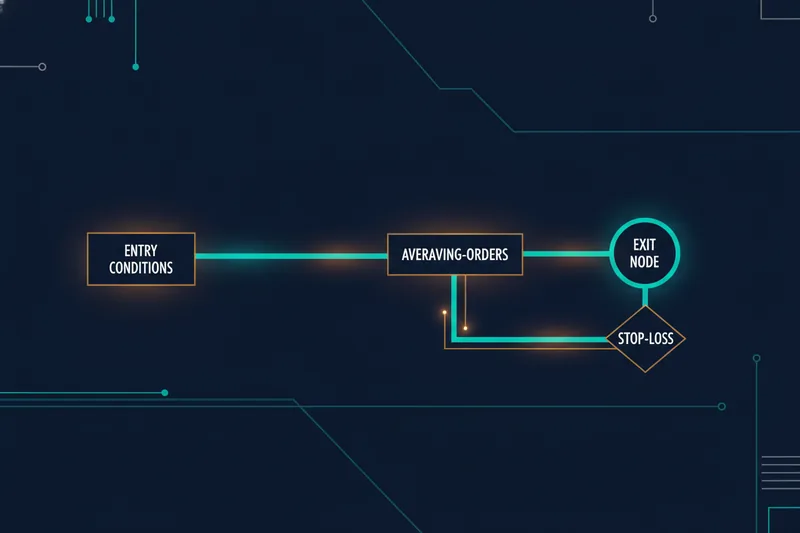
Quberas structures a strategy as a deal map — a drag-and-drop flow where entry conditions, averaging orders (adding to a position at defined intervals), exit rules, and stop-losses are each distinct, connected stages. Instead of scrolling through nested code blocks to find where an exit condition is defined, you see the whole trade lifecycle laid out as a flow, stage by stage.
Seeing exactly why a condition did or didn't trigger
Conditions themselves are built with a puzzle-style condition builder, combining price levels, indicators, volume, and crossovers into nested logic without writing a single line of syntax. The visual debugger then highlights the exact chart zones tied to each condition, and shows how close a rule came to triggering even when it didn't — the "almost vs. triggered" view that turns a rejected signal into useful information instead of a mystery, so you can adjust thresholds based on evidence rather than guesswork.
Backtesting a Forex Trading Bot Before Going Live
Backtesting runs your strategy's rules against historical OHLCV data (open, high, low, close, volume) to see how it would have performed in past market conditions before you commit real money. It's not optional — it's the step that tells you whether your entry and exit logic has any historical edge at all, and it lets you compare strategy variations side by side to see which combination of thresholds actually holds up.

Backtesting and forward testing (running the strategy live on a demo account) are both required stages a strategy needs to pass before real capital is on the line — neither one substitutes for the other, since historical fit doesn't guarantee live behavior. Within that same testing process, you should validate your risk layer too: confirm the stop-loss triggers where intended and, where a cooldown after stop-loss is available, check that it prevents the bot from re-entering immediately into the same losing condition.
Choosing the Right Forex Trading Bot for Your Strategy
Once you understand how bots work and what testing they need, choosing between options comes down to five practical questions:
- Transparency of logic: Can you see exactly which conditions trigger a trade, or are you trusting a compiled file?
- Cost vs. features: Does the price reflect ongoing support and updates, or is it a one-time download with no maintenance?
- Backtesting support: Can you run historical tests and compare variations before going live, not just after?
- Risk controls: Are stop-loss and position-sizing rules built into the strategy flow itself, not treated as an afterthought?
- Ease of adjustment: Can you change a threshold or add a condition without touching code, and see the impact immediately on the chart?
A bot that scores well on all five gives you something free EAs and most black-box paid bots don't: the ability to actually understand your own strategy.
FAQ
Are forex trading bots legal? Yes. Automated trading is legal in virtually every jurisdiction where retail forex trading itself is legal, provided you're using it on a licensed broker's platform and complying with that broker's terms of service.
Can forex bots make $1000 a day? Not reliably, and any bot marketed around a fixed daily dollar target should be treated with suspicion. Returns depend on account size, position sizing, and market conditions — a bot producing consistent fixed dollar amounts regardless of capital or volatility isn't a realistic claim.
Do I need MetaTrader to use a forex bot? No. MetaTrader 4/5 is required only for EAs built specifically in MQL4/MQL5. No-code platforms like Quberas build and run strategy logic independently of MetaTrader, connecting to supported brokers or exchanges directly.
Is a free forex bot safe to use? It can be, but only after you've verified its logic is inspectable, tested it on a demo account, and confirmed it's actively maintained. Treat "safe" as something you verify yourself, not something a free listing guarantees.
If you want to stop guessing what's inside your bot's logic, try building your own transparent forex trading bot on Quberas — no coding required, and every trigger visible on the chart before you go live.