Auto Trading Websites: How They Work | Quberas
Automated trading websites fall into four fairly distinct categories — broker execution tools, coded bot platforms, copy trading services, and no-code visual builders — and the "right" one depends less on brand reputation than on whether you can actually see and verify the logic before it touches your money. This guide compares them by that transparency criterion, walks through how automated trading works mechanically, and gives an honest answer on whether it's profitable and what to check before you commit capital to any of them.
What Is Automated Trading, and How Do Auto Trading Websites Work?
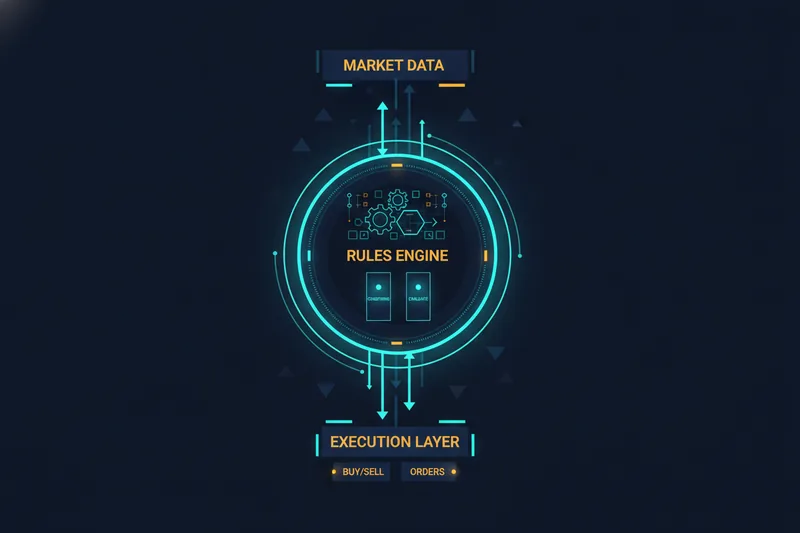
What automated trading means
Algorithmic trading is the practice of defining trading rules — entry conditions, exit conditions, position sizing — as a fixed set of instructions instead of judgment calls made trade by trade. Automated trading is what happens when those rules are handed to software that executes them without a human clicking "buy" or "sell" each time. The two terms get used interchangeably, but algorithmic trading is really about the rule design, while automated trading is about the execution layer that carries it out.
Auto trading websites are the products built around that execution layer. Practically, day-trading software tends to break down into three functional pillars rather than two: the platform that places and manages orders, the market data feed that supplies prices, and the analytics or journaling layer used to review what happened afterward. Most auto trading websites bundle at least the first two; the better ones also give you a way to review and refine, not just execute.
How a trade rule gets built, tested, and executed via broker/exchange APIs

Under the hood, an automated strategy is a set of conditions — price crossing a moving average, an indicator hitting a threshold, volume spiking — connected to actions (open, add, close). The platform watches live market data against those conditions and, when they're met, sends an order through an API (a programmatic connection that lets one piece of software talk to another) to a broker or exchange. That broker or exchange is what actually holds your funds and fills the order — stocks, crypto, options, and futures brokers all expose different flavors of these connections, with different order types and latency characteristics. The auto trading website's job is to translate your conditions into that order correctly, every time, without you having to place it manually.
The Main Types of Auto Trading Platforms
Four categories cover almost every product marketed as an "auto trading website" today.
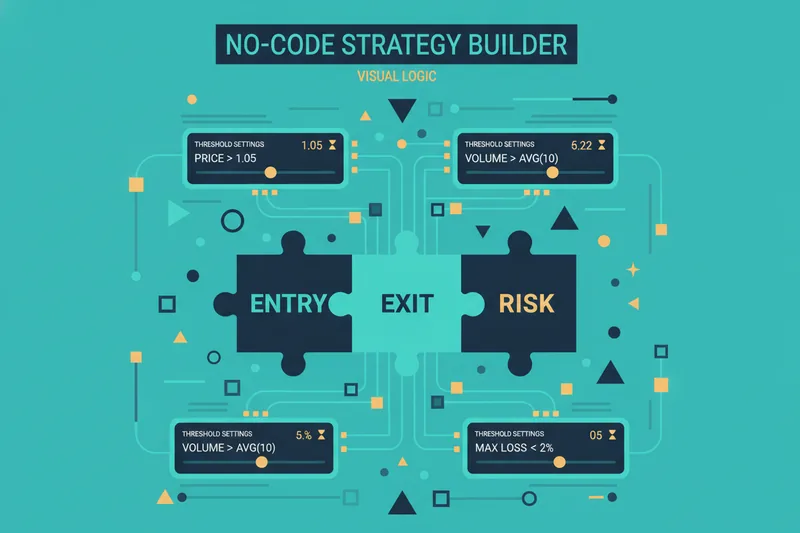
No-code strategy builders let you assemble entry, exit, and risk logic visually — dragging in indicators and setting thresholds through a UI instead of writing code. The tradeoff is usually flexibility for accessibility: you're working within the blocks the platform gives you, but you can see every condition plainly.
Coded or API-based bot platforms give you a scripting environment, often Python, to write custom logic directly. Tools like AlgoBuilder fall here, offering structured ways to build, backtest, and deploy rule-based strategies through code rather than a visual interface. These platforms offer the most flexibility but require programming ability and generally more effort to audit — bugs in the code are your bugs.
Copy trading services let you mirror another trader's live positions automatically instead of defining your own rules at all. You're not building logic; you're outsourcing it, usually for a performance fee — in crypto copy trading, lead traders typically take 10–20% of the net profits their followers earn. Copy trading and algorithmic trading solve different problems: one automates someone else's decisions, the other automates yours.
AI-driven trading bots use models — including, increasingly, large language models connected to live market feeds, historical data, and execution infrastructure — to generate or adjust trading decisions. Tools once reserved for institutional desks are now being packaged for retail traders, but "AI-driven" doesn't automatically mean transparent; many of these operate as a black box where you see outputs, not reasoning.
Best Auto Trading Websites and Platforms Compared
Broker-integrated auto trading (stocks, crypto, options, futures)
Most stock, crypto, options, and futures brokers now offer some form of native automation — conditional orders, basic strategy templates, or API access for third-party tools. Futures brokers in particular compete heavily on cost of entry: some charge no monthly platform fee and instead charge per-contract commissions in the $0.20–$1.29 range depending on contract size, while a broker like AMP Futures asks for as little as a $100 minimum deposit to open an account. Broker-native automation is convenient if you're already trading there, but the rule-building tools are usually secondary features, not the product's focus — you often can't see a condition's history visually before it fires.
Standalone bot/automation tools
These connect to a broker or exchange via API and run independently. TradingView integration is common here: many traders build alerts or strategies in TradingView's charting environment and pipe signals out to an execution bot. This setup is powerful but fragmented — your charting, your logic, and your execution can live in three different places, which makes it harder to trust that what you tested is exactly what's running live.
Visual no-code platforms like Quberas
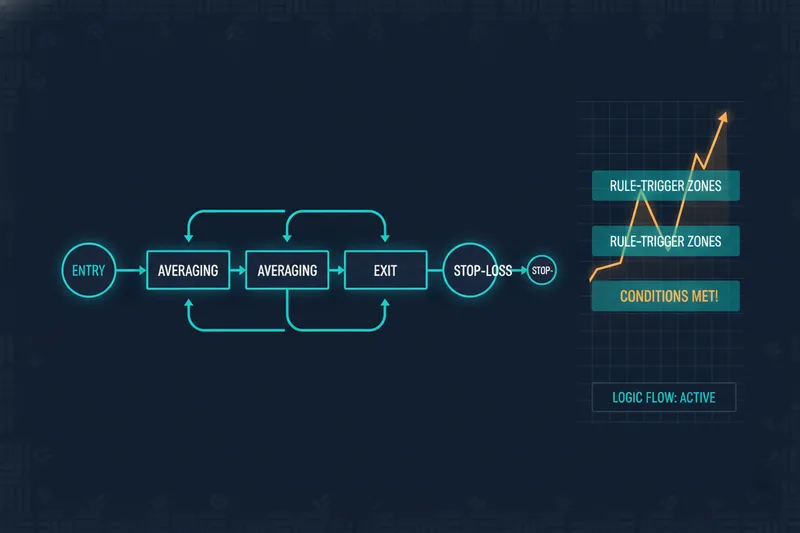
The category built specifically to close that gap is the no-code visual strategy builder. On Quberas, a strategy is built as a deal map — a visual, stage-by-stage layout of entry, averaging, exit, and stop-loss logic — so you can see how the pieces connect instead of inferring it from parameters buried in a settings panel. Conditions are backtested against historical data before anything goes live, and a strategy marketplace lets you launch a strategy someone else has already built and shared, rather than starting from a blank canvas. The differentiator versus both broker tools and coded bots isn't more features — it's that the logic is visible on the chart itself.
Automated Trading for Beginners: Is a No-Code Platform an Easier Start?
For someone with no programming background, a no-code strategy builder is generally the lower-friction entry point into automated trading. The barrier to writing a working Python bot isn't just syntax — it's debugging logic errors you can't see, which is exactly the step a visual condition builder removes: you place a rule on the chart, and you can watch where it would have triggered historically.
That said, "easier" doesn't mean "no learning curve." Beginners still need to understand what backtesting actually validates (past conditions, not guaranteed future ones), what an indicator threshold represents, and how to size a position responsibly. A reasonable onboarding path looks like: pick one or two conditions you understand well, build them visually, backtest across a meaningful stretch of historical data, and only then consider a small live allocation. Free or low-cost entry points matter here — you want to be able to build and backtest several variations before paying for anything, because your first version is rarely your best one.
Is Automated Trading Profitable? Setting Realistic Expectations
Automated trading can be profitable, but the honest answer is that profitability depends entirely on the quality of the strategy and how rigorously it was validated — not on the fact that it's automated. Automation removes emotion and execution lag; it doesn't add an edge that wasn't in the rules to begin with.
Two testing stages are generally both required before a strategy is considered ready for real capital: backtesting against historical price data, and forward testing (running it live on a demo or small size) — neither one substitutes for the other. Backtesting typically runs against OHLCV data (Open, High, Low, Close, Volume — the standard historical price-and-volume record for a given interval), though more precise testing can incorporate bid/ask spreads or order-book data for strategies sensitive to execution quality, like scalping setups that operate on 1-to-15-minute charts where spread and timing matter as much as direction.
If you want a numeric anchor for "is this actually good," a common risk-adjusted performance metric is the Sharpe ratio: above 1.0 is considered acceptable, above 2.0 very good, and above 3.0 excellent. Beware any backtest result that looks exceptional without forward-test confirmation — that's usually a sign of overfitting, not skill, which the next section covers directly.
Risks and Pros/Cons of Auto Trading
Common risks (technical, market, over-fitting)
- Technical risk: a dropped API connection, an exchange outage, or a platform bug can leave orders unexecuted or duplicated at the worst moment.
- Market risk: a strategy tuned for one volatility regime can behave very differently when conditions shift — no rule set is immune to a market that stops behaving like its backtest.
- Over-fitting: tightening parameters until a backtest looks perfect usually means the strategy has memorized past noise rather than found a durable edge; it tends to fail forward.
- False signals: thresholds set too loosely trigger on noise rather than real moves, producing a string of small, draining losses rather than one big mistake.
Built-in risk controls to look for
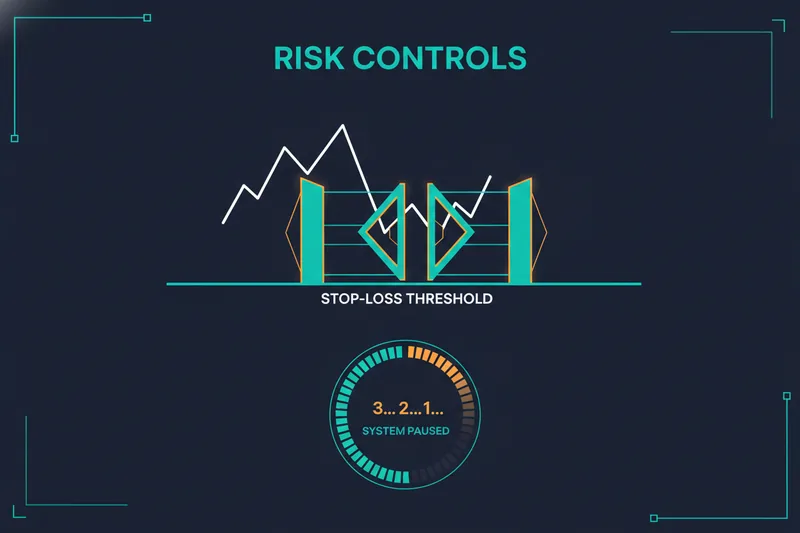
A stop-loss — a rule that closes a losing position once it hits a defined threshold — is the baseline control any auto trading website should support natively, not as an afterthought. A cooldown period after a stop-loss (a forced pause before the strategy can re-enter) helps prevent a bot from immediately re-triggering into the same losing condition repeatedly. Beyond individual trades, disciplined risk sizing at the account level matters too: one widely used framework, the 3-5-7 rule, caps risk at 3% per trade, 5% across all open positions at once, and requires at least a 7% profit-to-loss ratio — the specific numbers matter less than having some explicit cap you enforce mechanically rather than trusting yourself to remember it mid-drawdown. When you're comparing platforms, check whether stop-loss and cooldown logic live inside the strategy itself (visible and testable) or depend on you manually intervening.
How to Choose the Right Auto Trading Website
Selection criteria checklist
- Transparency of logic — can you see exactly which condition triggered a trade, or only the outcome?
- Backtesting quality — does it test against real OHLCV history, and does it support forward testing before going live?
- Broker/exchange coverage — does it connect to the markets you actually trade (stocks, crypto, options, futures)?
- No-code strategy builder vs. code requirement — matches your technical comfort and how fast you want to iterate.
- Risk controls — native stop-loss, cooldown, and position-level limits, not bolted-on add-ons.
- Strategy marketplace — an option to start from a vetted strategy rather than building blind on day one.
Using a strategy marketplace: launch ready-made strategies or publish and monetize your own
A strategy marketplace changes the calculus for beginners and experienced traders alike. Instead of building from zero, you can select an existing published strategy, set your own risk parameters, backtest it against your target market, and launch it — skipping the trial-and-error of a first build. On the other side, if you develop a strategy that performs well, some platforms let you publish it publicly or share it via a private link with a whitelist, and earn recurring payouts when others use it, with commission terms varying by plan. This is a genuine differentiator most broker-affiliate roundups skip entirely, because broker-native tools and coded bot frameworks rarely have a marketplace layer at all.
FAQ
Does automated trading really work? It works in the sense that rules execute exactly as written, without hesitation or emotion. Whether it's profitable depends on the quality of those rules and how well they were backtested and forward-tested — automation is an execution method, not a strategy.
Can I make $1000 a day day trading? Some traders do, on some days, with enough capital and a validated edge — but it's not a realistic baseline expectation, and daily targets like this ignore drawdowns, which every strategy eventually has. Judge a strategy by risk-adjusted metrics like the Sharpe ratio over time, not by a single best day.
AI trading bots vs no-code builders — what's the real difference? AI-driven bots generate or adjust decisions using a model, sometimes an LLM connected to live data and execution, and the reasoning behind a given trade isn't always visible. No-code builders like a deal map-based platform let you define every condition yourself and see it triggering on the chart — less automated decision-making, more visible control.
Copy trading vs algo trading — which should I use? Copy trading automates someone else's live decisions for a performance fee, typically 10–20% of profits; algo trading automates your own rules. Choose copy trading if you want exposure without building logic; choose algo trading if you want to understand and control exactly why every trade happens.
If you want to see what that looks like before risking anything — build a strategy visually, watch its conditions trigger on the chart, and backtest it against historical data — you can build and backtest your first bot free on Quberas.