AutoCrypto: Automate Crypto Trading Without Code
If you've searched "autocrypto" hoping to understand how to automate your crypto trading, you've probably landed on a wall of price charts for the AU token. This guide is for the other search — the one behind the question: how do I actually automate my crypto strategy without writing code? Here's a plain-language breakdown of how crypto trading automation works, why transparent rule-based strategies beat black-box AI bots for most traders, and how to go from a manual trading idea to a live bot — no programming required.
What Is AutoCrypto? Clearing Up the Confusion
AutoCrypto (AU token) is a cryptocurrency project, and it tends to appear prominently in search results for this term. If you're looking for its price, market cap, or exchange listings, you're in the wrong place — but you're not alone in landing here.
The more useful meaning of "autocrypto" is the concept most traders are actually hunting for: automated crypto trading, the practice of using software to execute trades automatically based on predefined rules. When traders search this term, they're typically asking one of three things: What is crypto trading automation? How does it work? And how do I build a strategy without being a developer?
Crypto trading automation means replacing manual order placement with a system that monitors the market continuously, evaluates conditions you've defined, and fires trades when those conditions are met — without you needing to watch a screen. That's the subject of this guide.
How Automated Crypto Trading Works

What a Trading Bot Actually Does
A trading bot is not a magic money machine. At its core, it is a rule-execution engine: a program that reads market data, checks whether your conditions are true, and places orders accordingly. Crypto markets operate around the clock with no fixed daily close, and a bot doesn't sleep, miss a signal, or hesitate.
The bot's behavior is entirely determined by the algorithmic trading strategies you give it. If you tell it to buy when a certain indicator crosses a threshold and sell when price hits a target, it will do exactly that — nothing more, nothing less. The quality of the strategy is what determines the outcome.
The Role of Indicators and Conditions
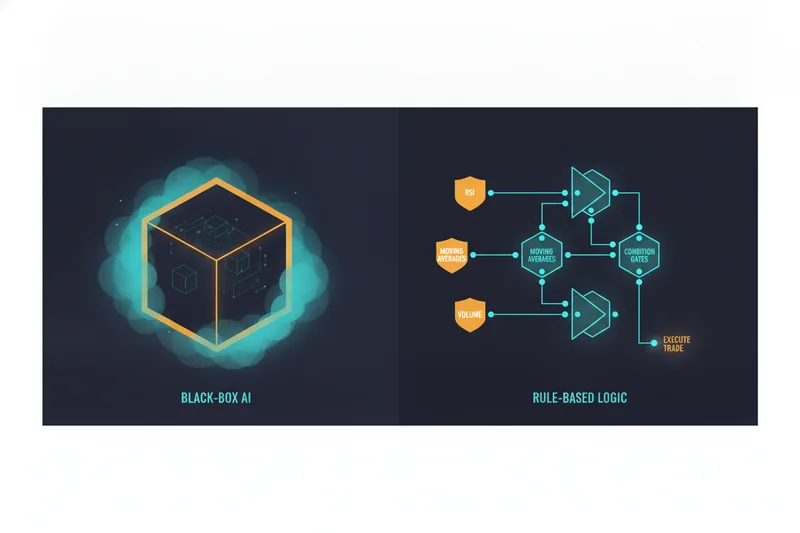
Bots read the market through trading indicators — mathematical calculations applied to price and volume data. Common examples include:
- RSI (Relative Strength Index) — a momentum-based indicator that traders commonly apply to gauge the relative strength of recent price moves
- Moving averages — calculations derived from price data over a chosen period, often used to get a smoothed view of price direction
- Volume — tracks how much of an asset is being traded, used to confirm or question price moves
These indicators become inputs to your entry and exit conditions — the logical rules that tell the bot when to open a trade and when to close it. For example: enter when RSI drops below 30 and price is above the 50-period moving average; exit when price rises 5% or RSI crosses back above 50. When those conditions are satisfied simultaneously, the bot executes the order automatically.
AI-Powered Bots vs. Rule-Based Algorithmic Trading
The Black-Box Problem with AI Crypto Bots
AI-powered trading bots use machine learning models to make trading decisions. The appeal is obvious — the algorithm adapts, learns from data, and doesn't require you to define every rule manually. The problem is opacity.
With most AI crypto bots, you cannot see why a trade fired. The model weights that drove the decision are invisible to you. When the bot loses money, you have no clear path to understanding what went wrong or how to fix it. You're trusting a black box with real capital, and if market conditions shift in a way the model wasn't trained for, the losses can be significant before you even notice the pattern has broken down.
Why Rule-Based Strategies Give You Full Control
Rule-based trading is the alternative: you define every condition, every trigger, every exit. The bot does exactly what you told it to do — no more, no less. This transparency is not a limitation; it's a feature.
When you can see exactly which conditions triggered a trade, you can evaluate whether the logic makes sense, identify which rules are underperforming, and iterate with precision. Before going live with any automated strategy, that visibility is essential. A strategy you understand is one you can improve. A strategy you can't inspect is one you can only hope works — and hope is not a risk management plan.
The trade-off is real: rule-based strategies require you to think through your logic upfront. But for most retail and intermediate traders, that discipline is exactly what separates systematic trading from gambling.
No-Code Tools for Building Your Own Crypto Trading Bot
What a Visual Strategy Builder Looks Like

No-code trading automation has made rule-based strategy building accessible to traders who have no programming background. Instead of writing scripts, you work in a visual interface — dragging, connecting, and configuring logic blocks that represent your trading rules.
A visual strategy builder typically presents your strategy as a flowchart or map of connected conditions and actions. You can see the full structure of your bot at a glance: where it enters, how it manages open positions, where it exits, and what triggers a stop-loss. This is the category of tool that makes transparent algorithmic trading practical for self-directed traders.
Defining Entry Conditions, Exits, and Stop-Losses Without Code
The core interface in this type of platform is a deal map — a visual canvas where you lay out the full lifecycle of a trade. Entry conditions, averaging orders (for strategies that add to positions), take-profit exits, and stop-loss rules are all mapped as connected nodes rather than lines of code.
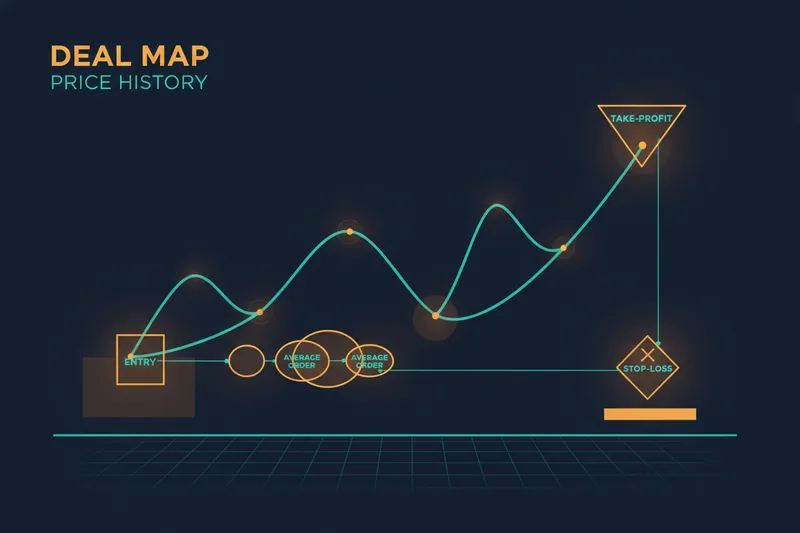
Nested logic — for example, "enter only if RSI is below 30 AND volume is above its 20-period average AND price is above the 200-period moving average" — is handled through a puzzle-style condition builder that lets you stack and combine conditions without syntax errors or debugging sessions.
The critical feature that separates a good visual builder from a basic one is a visual debugger: the ability to see exactly where your rules triggered on a historical chart. When you can look at a price chart and see highlighted zones where each condition was active, you stop guessing and start understanding. Quberas is built around this principle — every condition you define maps directly to a visible zone on the chart, so you know precisely what your bot would have done and why.
This approach is designed for retail and intermediate traders who have real trading ideas but no interest in learning Python or maintaining a codebase.
Backtesting Your Automated Crypto Strategy Before Going Live
What Backtesting Tells You About Your Strategy
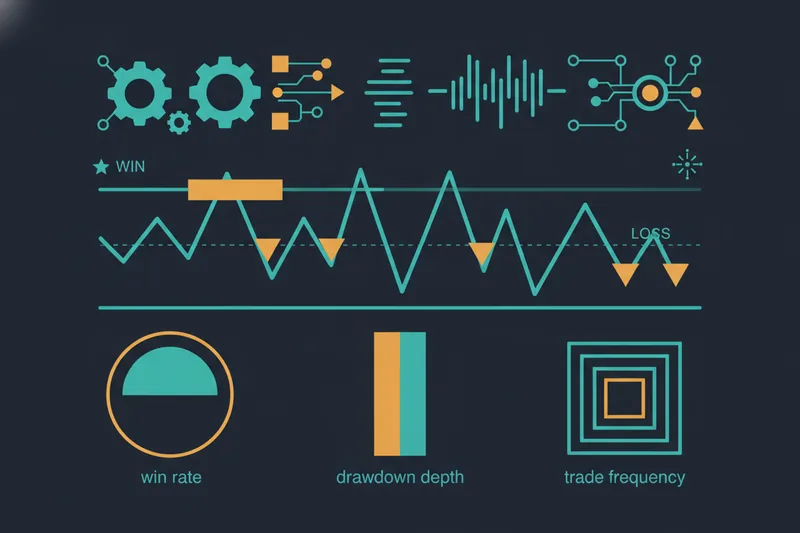
Backtesting means running your strategy's logic against historical market data to see how it would have performed. Before you risk a single dollar of live capital, backtesting tells you whether your rules have any edge — or whether they would have lost money consistently across different market conditions.
It's not a guarantee of future performance, but it is the only rational way to validate a strategy before deploying it. Skipping backtesting is the equivalent of publishing code you've never run.
How to Read and Act on Backtest Results
When reviewing backtest output, focus on three things:
- Win rate — what percentage of trades closed profitably. A high win rate isn't automatically good if losing trades are much larger than winners.
- Drawdown — a measure of how far the strategy's value fell from a prior high during the test period. This tells you how much pain the strategy would have inflicted before recovering, and whether you could realistically stomach it.
- Trade frequency — how often the strategy fires. Too few trades and you have insufficient data to trust the results; too many and transaction costs may erode any edge.
Use backtest results to iterate on your conditions. If drawdown is too high, tighten your stop-loss rules. If trade frequency is too low, loosen an entry condition and re-run. This feedback loop — build, test, adjust, re-test — is the core of systematic strategy development, and it belongs entirely in the backtesting phase, not in live trading.
How to Get Started with Automated Crypto Trading
The path from a manual trading idea to a live automated strategy follows four clear steps. No prior coding is required at any stage.
Step 1: Define Your Trading Logic
Before you open any tool, write down your strategy in plain language. What market condition triggers an entry? What's your target exit? Where does the trade become a loss you're willing to cut? If you can't describe your rules in plain sentences, you're not ready to automate them — and that's useful information.
Step 2: Build and Visualize It
Translate those rules into a visual strategy builder. Map your entry conditions, exits, and stop-loss onto a deal map. Use the condition builder to stack any nested logic. At this stage, the goal is to see your strategy's full structure — every branch, every trigger — laid out clearly before any money is involved.
Step 3: Backtest and Refine
Run your strategy against historical data. Review win rate, drawdown, and trade frequency. Adjust conditions that aren't performing as expected and re-run until the results reflect a strategy you'd be comfortable deploying. This iteration is where most of the real work happens — and where most traders who skip it pay the price later.
Step 4: Launch Your Bot
Once backtesting results are satisfactory, connect your strategy to a live exchange and deploy. Because crypto markets operate continuously with no fixed close, automation means your strategy runs without gaps — capturing moves during off-hours, overnight sessions, and weekend volatility that manual traders simply miss.
A well-defined, backtested, rule-based bot keeps working while you don't.
Ready to build your own automated crypto strategy — and actually see how it works? Try Quberas free and map your first trading bot without writing a single line of code.