Index Futures Explained: Trade Systematically
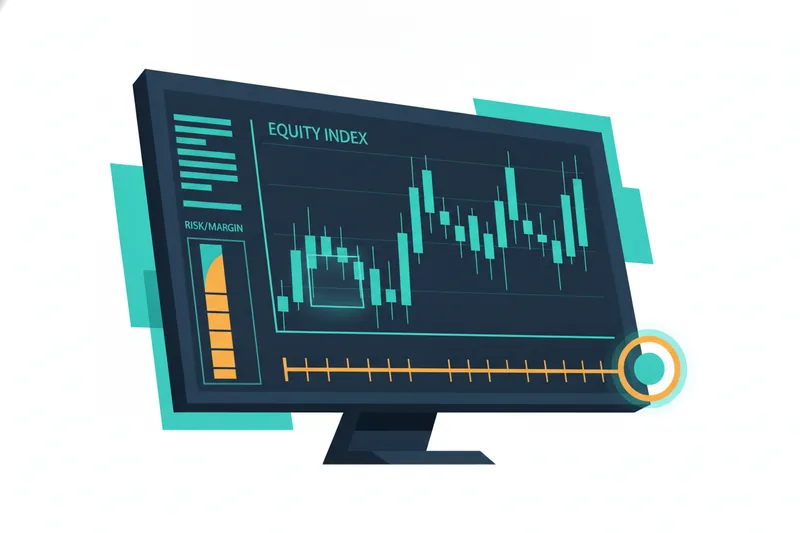
Index futures are standardized contracts that let you buy or sell the future value of a stock market index — like the S&P 500 or Nasdaq 100 — on a set date, without ever owning the underlying stocks. They exist so traders and institutions can gain exposure to, or protect against, broad market moves using leverage, extended hours, and cash settlement instead of holding a basket of shares. This guide covers how the contracts actually work, what separates the major index futures products, and how to turn a manual "watch and react" approach into rules you can test before risking capital.
What Are Index Futures?
Stock index futures are derivative contracts obligating the buyer to purchase, and the seller to sell, the cash value of an underlying index at a predetermined price on a specific future date. Unlike buying shares of an S&P 500 ETF, you're not purchasing any company stock — you're trading a contract whose value tracks the index's level.
Each contract has a standardized size, tick value, and expiration cycle set by the exchange that lists it. In the U.S., that's primarily the CME Group's futures exchange, which lists the major equity index products traded around the clock in electronic markets. Because the contract terms are fixed by the exchange rather than negotiated between two parties, index futures are far more liquid and transparent than equivalent over-the-counter instruments — pricing, expiration dates, and margin rules are published and identical for every participant.
A trader new to the space with a background in stocks but no experience in derivatives — is where most confusion starts: index futures behave like a leveraged, time-limited proxy for the index, not like owning the market. That distinction shapes everything from position sizing to how you interpret a price move. It's also where tools like Quberas become useful for retail traders: rather than trusting a gut read on how a rule would have performed, you can define the exact conditions you'd act on and see them plotted against real price history before committing money.
How Index Futures Work
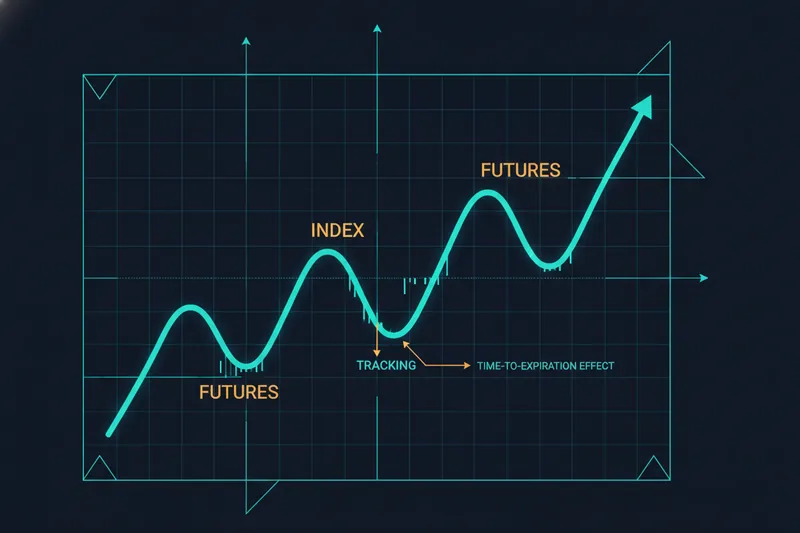
An index future's price moves in near lockstep with its underlying index, adjusted for the time value remaining until expiration and prevailing interest rates. If the S&P 500 index rises 1%, the corresponding futures contract typically moves almost identically, scaled by its point value.
Leverage and Margin Requirements
Index futures are traded on leverage and margin — you post a fraction of the contract's full notional value as collateral, called initial margin, and control the full contract value with it. If the E-mini S&P 500 contract represents roughly $250,000 of notional exposure, the margin required to hold it might be a small percentage of that, set and adjusted by the exchange based on volatility. This is the mechanism that makes index futures capital-efficient — and also the mechanism that makes losses (and gains) move faster than the underlying index's percentage change would suggest.
Positions are also mark-to-market daily: your account is credited or debited each day based on that session's settlement price, not just when you close the trade. Run a losing position for several sessions and margin gets drawn down in real time, well before you decide to exit.
Expiration and Settlement
Every index futures contract has a fixed expiration date, typically quarterly (March, June, September, December cycles for the major indices). At expiration, most equity index futures use cash settlement — no shares change hands. The difference between your entry price and the final settlement price is simply credited or debited to your account. Traders who want continuous exposure without settlement close their position before expiry and open a new one in the next contract month, a process known as rolling.
Types of Index Futures: S&P, Dow, and Nasdaq
The mechanics above apply to every equity index future, but the indices themselves behave differently because of what they track and how they're weighted:
- S&P 500 futures (E-mini and Micro E-mini variants) track 500 large-cap U.S. companies weighted by market capitalization. They're the most heavily traded index futures product and are often used as the default proxy for "the market."
- Dow futures track the Dow Jones Industrial Average, a price-weighted index of 30 large industrial and blue-chip companies. Because it's price-weighted rather than cap-weighted, a handful of high-priced stocks can swing the Dow disproportionately compared to their actual market size.
- Nasdaq futures track the Nasdaq-100, which is concentrated in large technology and growth companies. It tends to show sharper moves than the S&P 500 or Dow during earnings season or shifts in rate expectations, since tech valuations are more sensitive to discount-rate changes.
Choosing among them isn't about picking a "better" contract — it's about matching the index's composition and volatility profile to the exposure or hedge you actually want.
Hedging vs. Speculating with Index Futures
Index futures serve two fundamentally different purposes, and knowing which one you're doing changes how you should size and manage a position.
Hedging means using futures to offset risk you already hold elsewhere. A portfolio manager holding a diversified stock portfolio might sell S&P 500 futures to neutralize broad market risk ahead of an uncertain earnings season or macro event, without liquidating the underlying holdings. The goal isn't profit from the futures position itself — it's reducing the portfolio's net exposure temporarily.
Speculation means taking a directional position on where the index is headed, with no offsetting position elsewhere. A speculator who believes the Nasdaq-100 will fall on a rate decision sells Nasdaq futures outright, aiming to profit from the move itself. This is the more common use case for self-directed retail traders, and it's also the riskier one — there's no underlying position cushioning a wrong call, so leverage works fully against you as well as for you.
Index Futures as a Market Sentiment Indicator
Beyond trading them directly, index futures prices function as a real-time market sentiment indicator during hours when the cash equity market is closed. Because CME index futures trade nearly 24 hours a day, their price action before the opening bell reflects how overnight news — earnings releases, economic data, geopolitical events — is being digested before regular trading begins.
This is what financial media means by "stock futures are up" or "down" pre-market: it's not a prediction, it's the current price of the futures contract relative to its prior settlement, extrapolated as a signal for where the cash index will likely open. Pre-market price action in futures tends to compress a lot of information into a single number, which is exactly why it gets quoted so often — but it's also why treating it as a guarantee of the day's direction is a mistake. Futures can gap one way overnight and reverse entirely once actual cash-market liquidity and order flow kick in after the open.
Risks of Trading Index Futures
Are index futures risky? Mechanically, yes — more than most instruments retail traders encounter, for specific reasons rather than a vague "leverage is dangerous" warning:
- Leverage risk: because margin is a fraction of notional exposure, a moderate percentage move in the index translates into a much larger percentage move against your posted capital.
- Margin calls: daily mark-to-market means losses are realized against your account balance immediately, not just on paper. If equity falls below the maintenance margin threshold, the broker will require additional funds or close the position — often at the worst possible moment.
- Volatility: index futures react instantly to macro releases, central bank decisions, and index rebalancing events, producing sharp, fast moves with limited warning.
- Overnight gap risk: because futures trade nearly around the clock, a position held overnight is exposed to news that breaks while regular markets — and often your ability to react quickly — are closed.
None of this makes index futures unsuitable for retail traders; it makes ad hoc, discretionary decision-making under leverage a genuinely fragile approach. That's the case for building rules in advance rather than deciding in the moment.
How to Trade Index Futures Systematically
Algorithmic/systematic trading means defining your entry, exit, and risk logic as explicit rules ahead of time, then executing (or automating) exactly those rules rather than reacting case by case. For an instrument as leveraged and fast-moving as index futures, that consistency is the main defense against the risks above.
Turning Price Action Into Rule-Based Conditions
Instead of "I'll short if the Nasdaq looks weak pre-market," a systematic version specifies exactly what "weak" means: for example, price below the prior day's settlement combined with a moving-average crossover on a defined timeframe, or a volume spike beyond a set threshold. These become explicit entry and exit conditions — testable, repeatable, and reviewable after the fact.
A structured risk framework can be just as rule-based as the entry logic itself. Some traders formalize this with fixed thresholds — for instance, capping risk on any single trade, capping aggregate risk across open positions, and requiring a minimum reward-to-risk ratio before a trade even qualifies as valid. The specific numbers vary by trader and account size, but the principle — pre-committing to limits instead of deciding under pressure — is what turns leverage from a liability into a managed variable.
This is where a no-code strategy builder like Quberas' visual deal-map interface fits into the workflow: you define entry conditions, averaging rules, exits, and a stop-loss as connected blocks, and the platform highlights the exact chart zones where each condition would have fired historically — so you can see whether your definition of "weak" actually captures the moves you intended, or fires on noise instead.
Backtesting Before Going Live
Backtesting means running your rule set against historical price data to see how it would have performed before risking live capital on index futures. This is the step that separates a strategy idea from a strategy — a rule that sounds logical in isolation frequently underperforms once tested against real data, because market conditions rarely repeat exactly.
When evaluating backtest results, raw profit isn't enough on its own — risk-adjusted performance matters more. One common benchmark: a Sharpe ratio above 1.0 is generally considered acceptable, above 2.0 is very good, and above 3.0 is excellent. A strategy that produces solid returns but a Sharpe ratio near zero is likely just riding leverage and luck, not a genuinely repeatable edge.
Quberas lets you backtest a visually built strategy against historical data, compare variations of the same rule set side by side, and inspect near-misses — conditions that almost triggered — to refine thresholds before any of it touches a live account.
FAQ
Are index futures the same as stock futures? No. Index futures track the value of a basket of stocks (an index like the S&P 500), settled in cash. Single-stock futures, where they trade, are contracts on one company's shares and can involve physical delivery depending on the exchange. Index futures are the far more commonly traded of the two among retail traders.
What are the trading hours for index futures? Major U.S. index futures trade nearly 24 hours a day, five days a week, on CME Globex, with a brief daily maintenance window. This is a key structural difference from the cash equity market, which trades roughly 9:30 a.m. to 4 p.m. Eastern.
What's the minimum capital needed to trade index futures? It depends heavily on the broker and contract size — Micro index futures require far less margin than Standard contracts, and some futures brokers set account minimums as low as $100 to open a funded account. That said, minimum-to-open and sufficient-to-trade-safely are different numbers; margin requirements plus a buffer for adverse moves is the realistic figure to plan around, not the account minimum alone.
Ready to turn index futures analysis into a testable strategy? Build and backtest your rules visually with Quberas — no coding required.