Copy Trading Platforms Explained: How They Work & What They Hide
Copy trading platforms let you automatically mirror another trader's positions in your own account, proportionally sized to your allocated capital. It's a legitimate shortcut for getting market exposure without building a strategy from scratch — but before you pick a platform, it's worth understanding exactly what the model gives you, what it withholds, and when you'd be better off owning the logic yourself.
What Copy Trading Actually Is (and How the Mechanism Works)
How trade replication works: from signal to execution
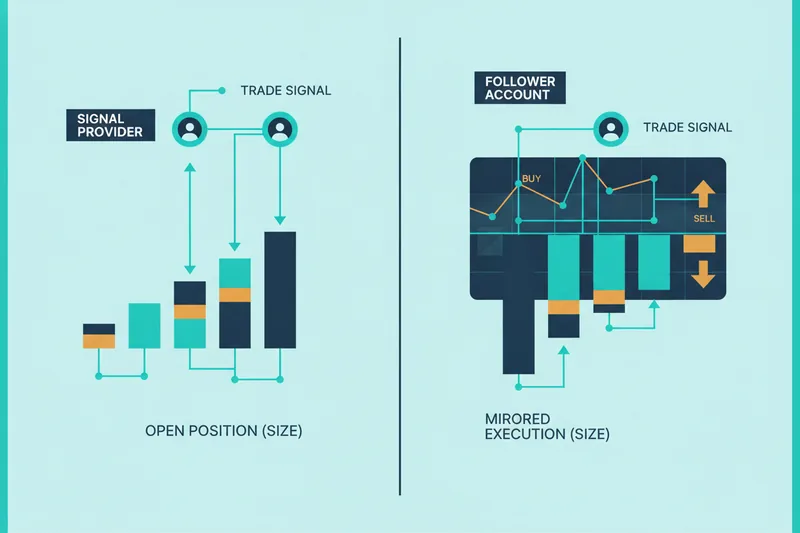
Copy trading is a mechanism where a follower's brokerage or exchange account automatically replicates the trades of a chosen signal provider (also called a lead trader). When the signal provider opens a position, the platform calculates a proportional equivalent for the follower's allocated capital and executes it in near real-time. If the provider risks 2% of their account on a EUR/USD long, a follower who has allocated $1,000 to copying them will open a position sized to the same 2% proportion — $20 in this case.
The key components are:
- Signal provider — the trader whose positions are broadcast
- Follower account — the account that receives and executes mirrored trades
- Trade replication engine — the platform layer that handles proportional sizing and order routing
- Allocation cap — the maximum capital the follower assigns to a single provider
Execution happens automatically. The follower does not approve individual trades; they set their allocation and risk parameters once, and the platform handles the rest.
Copy trading vs. social trading: what's the difference?
Social trading is the broader category. It includes any platform feature that lets traders observe, discuss, or act on other traders' activity — news feeds, public portfolios, performance leaderboards, and comment threads. Copy trading is a specific, automated subset of social trading: it doesn't just show you what someone is doing, it executes it in your account.
Trade copier software is a related but distinct concept. Rather than a built-in platform feature, it's a third-party tool (common in the MT4/MT5 ecosystem) that connects a master account to one or more subscriber accounts, often across different brokers. The mechanics are similar — proportional replication — but the setup is more manual and the follower typically needs to configure the connection themselves.
The Structural Limitation Nobody Talks About: You Are Copying a Black Box
What you cannot see when you copy a trade
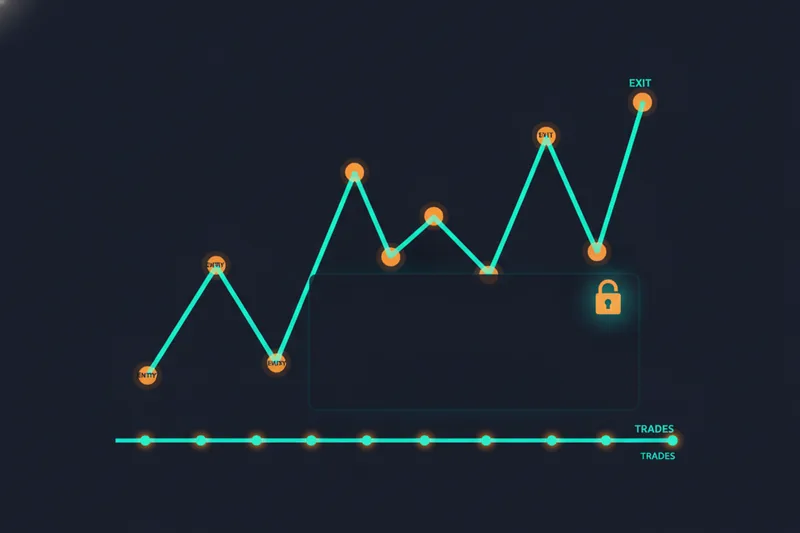
This is the part most platform reviews skip. When you copy a signal provider, you see their equity curve, their win rate, their average trade duration, and maybe their open positions. What you do not see:
- Why a trade triggered — which indicator conditions, price levels, or confluence factors the provider used
- Entry and exit conditions — whether they're trading a moving average crossover, a breakout, a discretionary read, or something else entirely
- Drawdown thresholds — at what point the provider's own risk rules would cut a position, and whether those rules are systematic or emotional
- Position sizing logic — whether the provider scales in, averages down, or uses fixed sizing
You are, in effect, trusting a black box. The strategy logic is completely opaque to you as a follower. You can see the outputs — the trade history — but you have no access to the rules that generated them.
Why past performance of a signal provider is not strategy validation
A signal provider's track record tells you what happened, not why it happened or whether it will continue. A six-month equity curve can look compelling and still reflect a strategy that only works in trending markets, or one that carries hidden tail risk through large uncapped drawdowns.
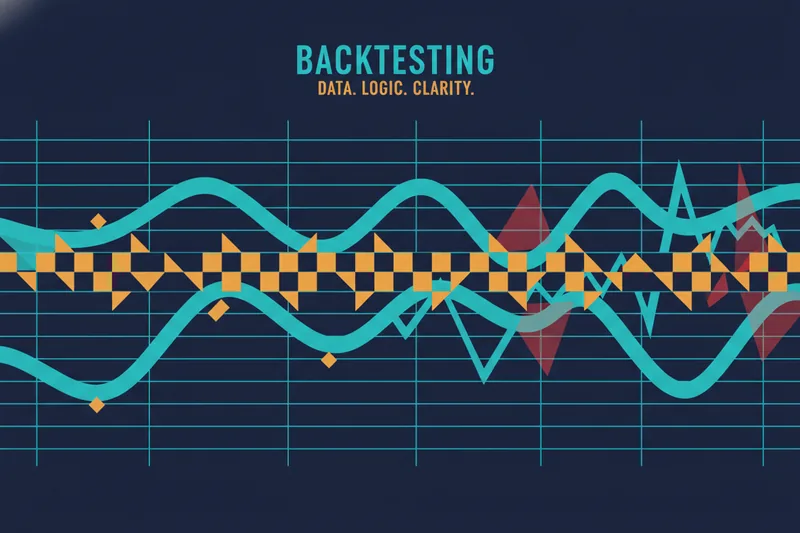
Backtesting — running a defined set of rules against historical price data — is how you validate whether a strategy's logic holds across different market conditions. But you can't backtest a strategy you can't see. The follower has no access to the underlying algorithmic trading strategy rules, so they have no way to stress-test the approach before committing real capital. That's a structural gap, not a platform-specific flaw.
How the Leading Copy Trading Platforms Compare
eToro CopyTrader: best known, equity-focused
eToro CopyTrader is the most widely recognized copy trading product. It operates within eToro's own brokerage, covering stocks, ETFs, crypto, and CFDs on forex and commodities. Followers allocate a minimum amount to a "Popular Investor" and the platform handles proportional replication automatically.
Fee model: eToro earns primarily through spread markup rather than explicit copy fees. There are no direct commissions on copy trades, but spreads on CFDs are wider than on direct-access brokers. Follower-side risk controls include a stop-loss on the copied portfolio (a maximum loss threshold that closes the copy relationship) and an allocation cap per provider.
ZuluTrade: signal marketplace with broker flexibility
ZuluTrade operates as a signal marketplace that sits on top of external brokers — including several regulated forex brokers — rather than being a broker itself. This means you can often use ZuluTrade's copy layer with a broker you already have an account with, which gives more flexibility on execution quality and regulation.
Signal providers on ZuluTrade earn performance-based fees. Followers can set per-trade lot limits, maximum open trades, and drawdown-based stop-out rules. The platform's ZuluRank algorithm attempts to surface providers with consistent risk-adjusted returns, though the underlying strategy logic remains opaque to followers.
Crypto-native copy trading platforms
Crypto copy trading is available natively on several major exchanges, including Bybit, Bitget, and OKX, each with their own lead trader programs. The mechanics mirror the traditional model: followers allocate funds, the platform replicates proportionally, and lead traders earn a share of profits from followers — the exact fee structure varies by exchange and is set individually by each lead trader within the platform's allowed range.
Key difference from forex-focused platforms: crypto markets run 24/7, which means execution lag between the provider's trade and the follower's fill can be more consequential during high-volatility periods. Follower-side controls vary by platform but generally include a maximum loss per trade and a total portfolio stop-loss.
Copy trading on MT5: what broker integration means in practice
MT5 (MetaTrader 5) supports copy trading natively through its Signals service and through third-party trade copier software. Broker integration here means the follower's MT5 account connects to a signal provider's account, and the terminal handles replication locally.
The practical implication: execution quality depends entirely on your broker's infrastructure, not the signal platform's. Slippage, requotes, and latency are broker-side variables. Pepperstone, for example, is a regulated broker that supports MT5 and is commonly used with third-party copy and signal tools, offering tight spreads and fast execution that reduce the friction inherent in copied trade fills.
Copy trading platforms for prop firm challenges: why full control matters
Using copy trading during a prop firm challenge — a funded account evaluation where you must hit a profit target without breaching a drawdown limit — is a high-risk approach. Most prop firms prohibit or restrict copy trading in their terms. Even where it's technically permitted, the follower has no control over when the signal provider trades, what drawdown the provider's strategy will incur, or whether the provider's risk profile matches the challenge's specific rules. Full control over your own strategy logic is not optional in this context — it's the only way to manage the challenge's constraints deliberately.
Can Copy Trading Be Profitable? An Honest Answer
Yes, copy trading can be profitable — but the honest answer is that profitability depends almost entirely on the validity of the underlying strategy, which the follower cannot audit.
The practical obstacles are real. Slippage and execution lag mean the follower's fills are rarely identical to the provider's. In fast-moving markets, a provider's entry at a specific price may result in a follower fill several pips or basis points worse, compressing the trade's expected edge. Over hundreds of trades, this friction accumulates.
Market regime changes are the deeper problem. A strategy that performed well in a trending, low-volatility environment may deteriorate sharply when conditions shift. Without visibility into the strategy's rules, the follower has no way to anticipate this — they only see the drawdown after it has started.
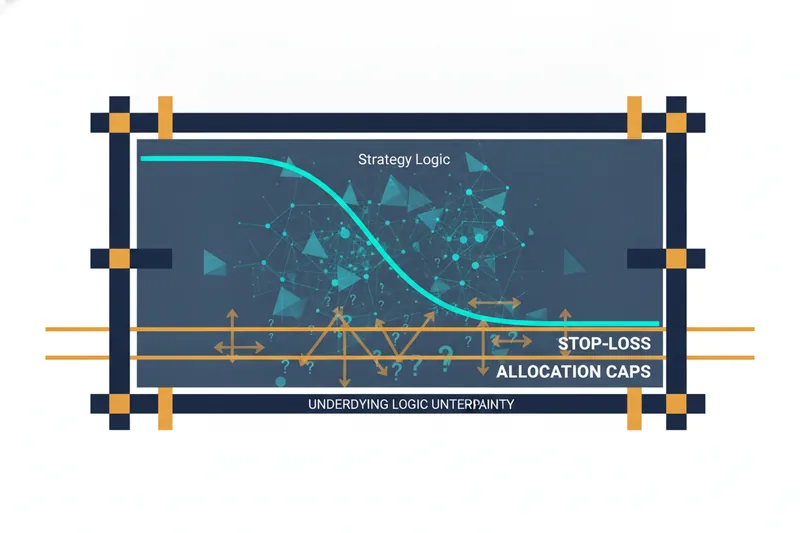
Risk management controls at the follower level (stop-loss on the copy portfolio, allocation caps) can limit the damage, but they don't address the root issue: you are applying risk controls to a strategy you don't understand. Backtesting and condition transparency are the missing ingredients. A strategy with defined, inspectable rules can be stress-tested against historical data — including periods of high volatility, ranging markets, and drawdown sequences — before a single dollar of live capital is committed. That validation step simply isn't available to a copy trading follower.
How to Choose a Copy Trading Platform: The Factors That Actually Matter
For beginners: what to prioritize when starting out
If you're new to trading and evaluating copy trading as a starting point, the factors that matter most are:
- Platform regulation and fund safety — is the platform or its underlying broker regulated by a recognized authority (FCA, ASIC, CySEC)? Are client funds segregated?
- Fee model transparency — understand whether you're paying through spread markup, performance fees, or subscription costs. Hidden fees compound over time.
- Follower-side risk controls — at minimum, you need the ability to set a maximum loss on your copied portfolio and cap your allocation per provider. Platforms that don't offer these controls give you no floor.
- Signal provider statistics depth — look for providers with at least 12 months of verified history, maximum drawdown figures, and a trade count large enough to be statistically meaningful. A 90% win rate over 20 trades is not a track record.
For advanced traders: when platform limitations become friction
For traders who already have a systematic approach, copy trading's structural constraints become increasingly limiting:
- Asset class and market coverage — if your strategy spans multiple asset classes or requires specific instruments, check whether the platform's broker integration covers them.
- Broker integration and execution quality — execution matters more as strategy complexity increases. Evaluate the broker's infrastructure, not just the copy layer on top of it.
- Transparency into signal provider logic — advanced traders will quickly find that the inability to inspect entry conditions, exit rules, or drawdown thresholds makes it impossible to evaluate whether a provider's approach is genuinely robust or just lucky.
Copy Trading vs. Building Your Own Automated Strategy
What you gain when you own the strategy logic
The fundamental difference between copy trading and building your own automated trading bot is ownership of the rules. When you define the strategy yourself, you know exactly which conditions trigger an entry, what causes an exit, and how the risk parameters interact. That transparency has compounding value: you can backtest the logic, identify weaknesses, adjust thresholds, and iterate — none of which is possible when you're following someone else's opaque system.
Copy trading makes sense as a starting point when you have no systematic approach of your own and want market exposure while you learn. It becomes friction when you have a view on how markets work and want to express it systematically, or when you need to manage risk to a specific set of constraints (as in a prop firm challenge).
How a no-code visual builder closes the gap between copy trading and full algorithmic control
The traditional objection to building your own strategy is the coding barrier. Writing a strategy in Python or Pine Script requires programming knowledge that most retail traders don't have and don't want to acquire.
A no-code strategy builder removes that barrier. Quberas uses a visual deal map — a drag-and-drop interface where you define entry conditions, averaging orders, exits, and stop-losses as connected stages, and see exactly where each rule triggers directly on the chart. The visual debugger highlights the chart zones tied to each condition, so you can see not just whether a trade triggered but why — which condition fired, how close others came to firing, and where thresholds need adjustment.
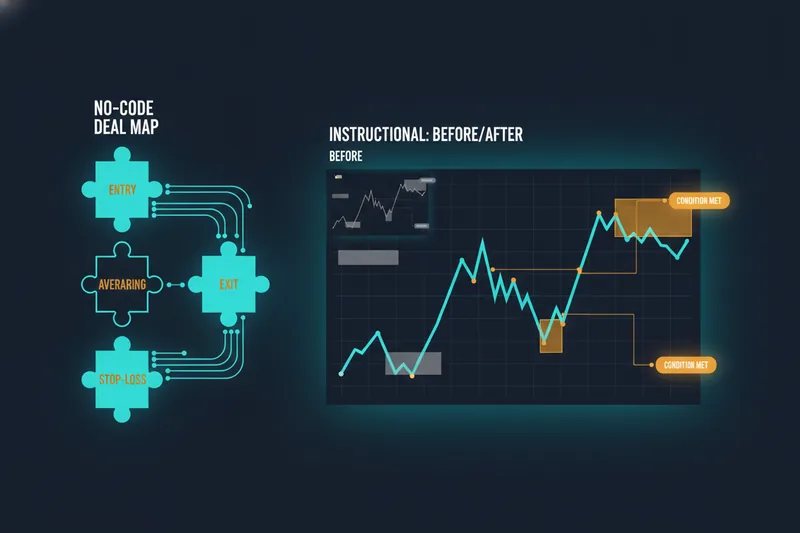
Backtesting on historical OHLCV data (open, high, low, close, volume) lets you validate the strategy's logic before going live. That's the step copy trading structurally cannot offer. Owning the logic means you can stress-test it, refine it, and understand its failure modes — rather than discovering them in real time with real capital.
Frequently Asked Questions
How much does copy trading cost? Costs vary by platform and model. Most platforms earn through spread markup on trades (meaning you pay slightly more than the raw market spread), performance fees charged by the signal provider (typically 10–30% of profits), or subscription fees for access to premium providers. Some platforms combine all three. Always calculate the total cost across all layers before allocating capital.
Is copy trading legal? Yes, copy trading is legal in most jurisdictions where retail trading is permitted. The platform or its underlying broker must be regulated in the relevant jurisdiction. Regulation varies — FCA (UK), ASIC (Australia), CySEC (Cyprus), and CFTC/NFA (US) are the main authorities. US residents face the most restrictions, as many copy trading platforms do not accept US clients due to regulatory complexity.
Can you copy trade crypto? Yes. Crypto copy trading is available on several major exchanges including Bybit, Bitget, and OKX, as well as on multi-asset platforms like eToro. The mechanics are the same as in forex copy trading, but the 24/7 market and higher volatility mean execution lag can have a larger impact on follower fills.
What is trade copier software? Trade copier software is a third-party tool that connects a master trading account to one or more follower accounts, replicating trades proportionally. It's most common in the MT4/MT5 ecosystem and is often used by traders who want to copy between their own accounts or distribute signals to a private group, rather than using a platform's built-in copy feature.
Is copy trading suitable for prop firm challenges? Generally no. Most prop firms prohibit copy trading in their terms of service, and even where it's technically allowed, the follower has no control over the signal provider's drawdown behavior — which makes it nearly impossible to stay within the challenge's specific risk limits. Prop firm challenges require deliberate, auditable risk management, which means owning and controlling your own strategy logic.
Ready to move beyond copying someone else's logic? Build, visualize, and backtest your own automated trading strategy — no code required — with Quberas.