Automated Stock Trading Explained | Quberas
Automated stock trading means a computer program — not you, in the moment — decides when to buy and sell, based on rules you define ahead of time. The rules can be as simple as "buy when price crosses above a moving average" or as layered as a multi-stage sequence with averaging orders and staged exits. This guide explains how automated trading actually works end to end, how it compares with trading by hand, what separates a black-box bot from a transparent one, and whether the whole approach is realistically profitable — before you connect a strategy to real capital.
What Is Automated Day Trading?
Automated trading systems are software that monitors market data and places orders automatically once predefined conditions are met, with no manual click required at the moment of execution. Algorithmic trading is the broader discipline behind this: turning a trading idea into a precise, repeatable set of rules a machine can evaluate. Trading bots are the running instances of those rules — the program that actually watches the market and fires orders.
Automated day trading applies this to short-holding-period strategies: positions opened and closed within the same session, or across a few hours, rather than held for weeks. It differs from manual trading, where a person reads the chart and decides in real time, and from semi-manual trading, where alerts flag opportunities but a human still pulls the trigger. What actually separates strategies from one another is the entry and exit conditions — the specific price, indicator, or volume thresholds that define when a position opens and closes. Day trading itself covers more than one style: scalping on very short timeframes of roughly one to fifteen minutes, where outcomes hinge on execution and spread rather than big market moves, alongside trend, range, gap, and breakout approaches that hold for longer within the same session. Automation doesn't pick the style for you — it just executes whichever one you've defined, consistently. That consistency gap is exactly what platforms like Quberas are built to close, by letting a trader see the rule triggering on the chart rather than trusting a black box to apply it correctly.
How Does Automated Trading Work?
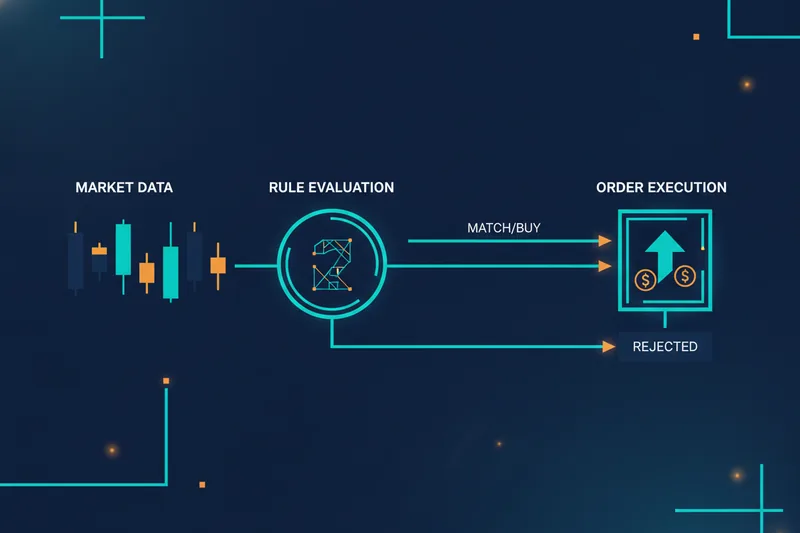
Every automated strategy, regardless of platform, runs through the same underlying pipeline: market data comes in, rules get evaluated against it, and qualifying signals get turned into orders. Day trading software as a category is generally organized around three pillars that support this — the trading platform that handles order execution, the market data feed that supplies prices, and analytics or journaling tools used to review what happened afterward.
From rule to execution: the automation pipeline
A live price feed streams into the system continuously. Each new candle or tick is checked against your entry and exit conditions. When conditions match, the system sends an order — typically through brokerage API integration, a direct programmatic connection between the strategy and your broker's order system, or via TradingView alerts/webhooks, where a chart-based alert triggers an external service that places the trade. Before any of this runs on live money, the same rule set gets run against historical data through backtesting, and risk management/stop-loss logic sits alongside the entry rules so that losing positions close automatically rather than waiting on a human to notice.
Where no-code builders fit in
A no-code strategy builder sits at the front of this pipeline. Instead of writing the conditional logic in a programming language, you assemble it visually — combining price, indicator, and volume conditions into rules the platform translates into executable logic. The mechanism underneath (data in, rules evaluated, orders out) doesn't change; what changes is whether you can see and verify that logic before it touches real money.
Automated vs Manual Day Trading: Pros and Cons
The core trade-off is speed and consistency versus flexibility and judgment.
Automated day trading executes exactly as programmed, at machine speed, every time a condition is met — it doesn't hesitate, doesn't second-guess an entry, and doesn't skip a stop-loss because the trade "feels" like it will turn around. That consistency is the main argument for automation: the same setup produces the same response, session after session, which removes the emotional discipline problem that undermines a lot of manual trading — fear cutting winners short, or hope holding losers too long.
Manual trading keeps the flexibility trade-offs in the trader's favor: a person can recognize an unusual news event, a liquidity gap, or a market regime shift that a rule set never anticipated, and adapt on the spot. Automation only does what it was told to do — it will keep applying yesterday's logic to a market that has fundamentally changed unless someone updates the rules. Neither approach is strictly better; automation trades adaptability for reliability, and that's a deliberate choice, not a free upgrade.
Types of Automated Trading Platforms and Bots (Compared)
Automated trading platforms don't come in just one mold, and picking one starts with knowing which category you're actually looking at. Three categories cover most of what a retail trader will encounter — black-box AI bots, code-heavy automation tools, and no-code visual builders — though pre-built strategy marketplaces, where you pick an existing strategy someone else built rather than assembling your own, are common too and worth knowing about separately.
Black-box AI bots
These platforms run trading decisions through opaque models — often marketed as AI trading bots — where you fund the bot and see results, but not the reasoning behind individual trades. AI-driven tools that were once limited to institutional desks are now widely available to retail traders, and some newer systems connect large language models directly to live market feeds and execution infrastructure. The appeal is convenience; the cost is that you can't verify why a specific trade fired.
Code-heavy automation tools
Other platforms give you full control through code — typically Python or a platform-specific scripting language — letting you build, backtest, and deploy rule-based strategies with precision. This category also includes Expert Advisors (EAs), and it's worth knowing that not every EA automates trading; some just enhance chart displays, while a separate EA actually places trades. Code-heavy tools are powerful but require programming skill to write and to debug.
No-code visual builders
A no-code strategy builder sits between the two: you define entry, exit, and risk logic by connecting conditions visually, without writing scripts, and — critically — you can see where those conditions sit on the chart rather than trusting a hidden model or a code review to catch mistakes. Some of these platforms also let you skip building altogether by selecting a ready-made strategy from a marketplace, setting your own risk parameters, and testing it before running it live — a middle path between the fully custom and fully opaque options above. Note also that platforms aren't identical even within a category — some focus specifically on stocks, ETFs, and futures, while crypto or forex are handled by separate, purpose-built tools under different products. Confirm which markets and which category a platform actually falls into before building around it.
Is Automated Day Trading Profitable? Does It Really Work?
Automation doesn't make a bad strategy profitable — it just executes it faster and more consistently. Profitability depends entirely on the quality of the underlying rules, not on the fact that a machine is running them.
The realistic way to answer "does it work" for your specific strategy is validation, not hope. Backtesting and forward testing are both considered necessary stages a strategy should pass before real capital is committed — neither one substitutes for the other. Backtesting shows how the rules would have performed on historical data; forward testing (often on a demo or small live size) confirms that performance holds up in current, not historical, conditions.
Risk management/stop-loss rules are part of that validation, not an afterthought. Some traders formalize this with fixed thresholds — one commonly cited framework caps risk at 3% per trade, 5% across all open positions at once, and requires a minimum 7% profit-to-loss ratio before a trade is considered worth taking. Whatever numbers you use, the point is the same: set them before you're live, and let the automation enforce them without exception.
How to Get Started with Automated Day Trading (Step-by-Step)
Step 1: Map entry, exit, and stop-loss conditions visually
Start by laying out the strategy as a deal map — a visual sequence covering the entry condition, any averaging orders, the exit rule, and the stop-loss, connected in order. Building this visually, rather than as buried code parameters, makes it possible to see the full sequence of a trade before it ever runs.
Step 2: Backtest before going live
Run the deal map against historical data to see how it would have performed. More precise backtests use bid/ask or order-book-derived data rather than plain OHLCV candles, since order-book data captures execution conditions closer to what a live order would actually face. Compare variations of the same strategy before committing to one.
Step 3: Launch and monitor performance
Once backtest results hold up, launch the strategy and watch it run against live conditions, checking that entries and exits fire where you expect. If you plan to run a bot continuously rather than testing intermittently, note that a home computer can work for testing, but reliability for live, real-money operation generally calls for infrastructure that stays online independent of your own machine.
Automated Day Trading for Beginners: Risks and Common Mistakes
Overfitting is the most common failure: tuning a strategy's parameters until it performs perfectly on historical data, when in reality it has just memorized that specific dataset's noise. An overfit strategy typically underperforms the moment it meets new, live conditions.
False signals are the second trap — conditions that technically trigger but reflect noise rather than a genuine setup, often from thresholds set too loosely. Reviewing how close a condition came to triggering, not just whether it did, helps separate real signals from noise before they cost money.
Ignoring risk management/stop-loss logic is the mistake that turns a mediocre strategy into a costly one; automation only protects you if the stop-loss rule is actually part of the deal map, not an assumption you'll intervene manually. It's also worth not confusing bot types: a Dollar-Cost-Averaging bot, for instance, buys or sells at fixed intervals over a set period — it does not build a position by adding at progressively lower prices the way an averaging-down entry sequence does. Treating backtesting as a one-time checkbox, rather than a repeated step whenever you adjust a rule, is the last common error worth naming.
FAQ: Automated Stock and Day Trading
Is automated stock trading legal for retail traders? Yes. Placing orders through a brokerage API or a TradingView webhook is a standard, broker-supported connection method — the trading rules and risk controls you set are your responsibility, but the mechanism itself is routinely available to retail accounts.
What's the difference between an automated stock trading platform and an AI trading bot? An automated stock trading platform executes rules you define and can typically show you those rules. AI trading bots make decisions through a model whose internal reasoning usually isn't visible trade by trade — you see the output, not the logic.
Does automated day trading remove the need to understand the market? No. You still need a strategy worth automating; the automation only removes manual execution and emotional interference, not the work of designing and validating sound entry and exit conditions.
Can I test a strategy before risking money? Yes — backtesting against historical data, followed by forward testing in current conditions, is the standard way to validate a strategy before it runs live.
Build and backtest your first automated trading strategy visually — no code required — with Quberas, and see exactly where your rules would have triggered before a single trade goes live.