Paper Trading: Complete Guide to Simulated Trading | Quberas
Paper trading lets you test a trading strategy using virtual money against real market conditions — no real capital at risk, no real losses. For manual traders, that means practicing order execution. For algo and rule-based traders, it means something more specific: confirming that your entry conditions, exit conditions, and stop-loss logic actually trigger the way you designed them before you deploy a single dollar live.
This guide covers both. You'll get a clear explanation of how paper trading works, how it differs from live trading, and — critically — how to use it to validate an automated strategy with full visibility into your logic.
What Is Paper Trading?
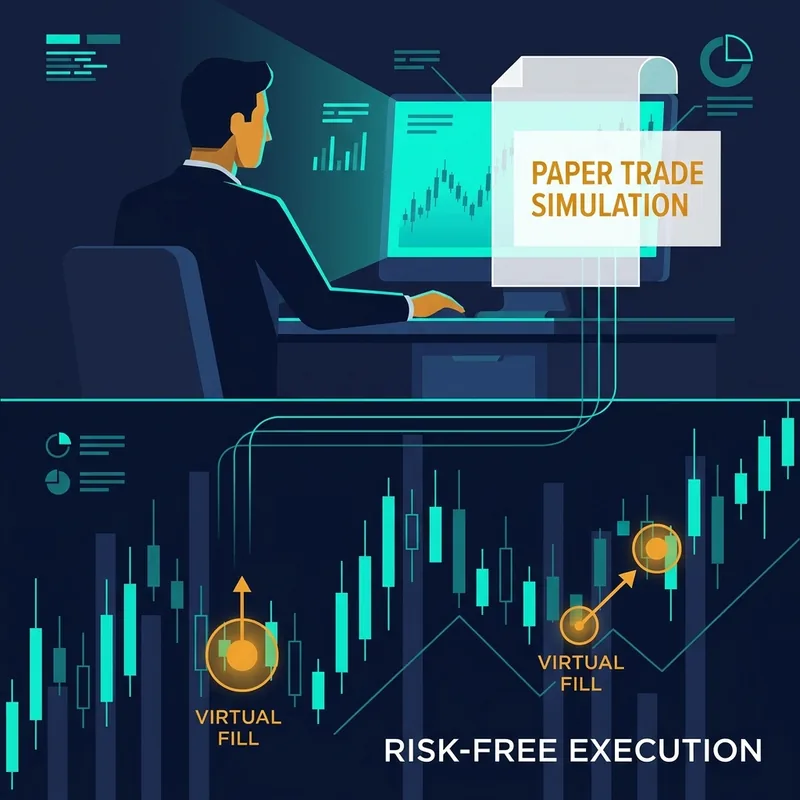
Paper trading is the practice of executing trades with virtual money — often called paper money — in a live or near-live market environment. No real capital is at risk. You're interacting with real-time market data, placing orders that follow real market prices, but the gains and losses exist only in a simulated portfolio.
The term comes from the pre-digital era, when traders would literally write down hypothetical trades on paper to track how they would have performed. Today, many brokers and trading platforms offer a demo account or paper trading mode that mirrors their live trading environment — same interface, same data feed, same order types — with a virtual starting balance in place of real funds. This kind of practice environment is also commonly referred to as a trading simulator or simulated trading environment, depending on the platform.
What makes paper trading useful isn't just that it's risk-free. It's that the market data feeding the simulation is real. Price moves, volume, volatility — all of it reflects what's actually happening in the market. That makes paper trading meaningfully different from purely hypothetical analysis, and meaningfully different from backtesting on historical data alone.
How Paper Trading Works
Opening a Paper Trading Account
Many brokers and trading platforms offer a paper trading account as a separate mode within the same application. Setup typically takes a few minutes: you create or log into your account, switch to the simulated environment, and receive a virtual portfolio balance in paper money. The exact starting amount varies by platform.
The key is that the virtual portfolio balance behaves like a real account in terms of how positions are tracked, how margin works (on platforms that support it), and how P&L is calculated. You're not just estimating — the platform is running real order logic against real prices.
Placing and Tracking Simulated Trades
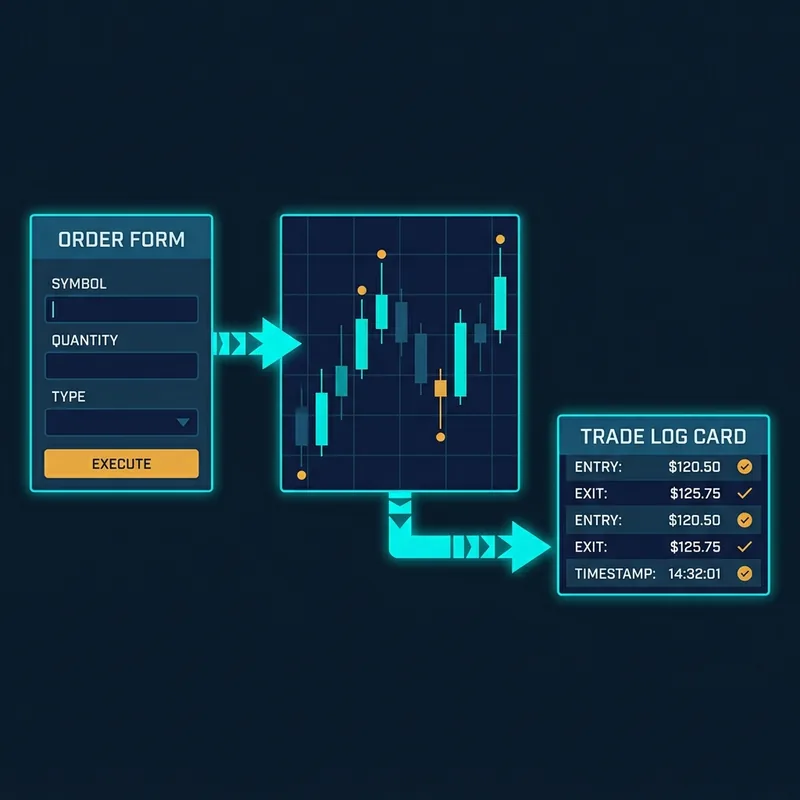
Once your paper account is active, you place orders the same way you would in a live account: market orders, limit orders, stop orders. The platform executes these against the real-time or historical market data feed it's connected to.
Simulated order execution records each trade — entry price, size, timestamp, exit price — and updates your virtual portfolio accordingly. You can track open positions, review closed trades, and monitor your running P&L, all without any real financial consequence.
The review step is where most of the value lives. After a session or a defined test period, you examine the trade log: which trades triggered, at what price, under what conditions, and what the outcome was. For manual traders, this reveals execution habits. For algo traders, it reveals whether the strategy's logic is behaving as intended.
Paper Trading vs. Live Trading: Key Differences
Paper trading is useful precisely because it approximates live trading — but "approximates" is the operative word. Several real-world factors are absent or simplified in simulation, and understanding them prevents you from over-trusting paper results.
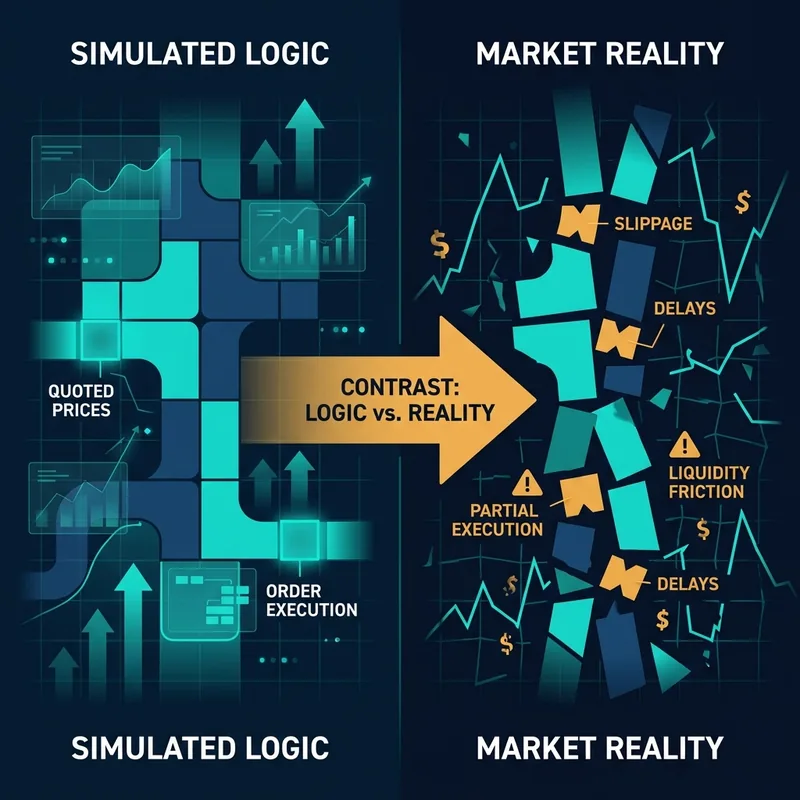
Slippage and execution differences are the most significant. In live markets, your order competes with other orders for fills. A market order placed at $50,000 might fill at $50,012 in a fast-moving market. Many paper trading simulators fill at the quoted price, which makes execution look cleaner than it actually is.
Liquidity and fill assumptions follow the same logic. A simulated platform will often assume your order gets filled in full, instantly. In live trading — especially in less liquid crypto pairs or during high-volatility events — partial fills and delayed execution are common. A strategy that looks smooth on paper may behave differently when real order book depth is involved.
Emotional discipline is entirely absent in paper trading. Watching a simulated position drop 15% feels nothing like watching real money do the same. This is the most frequently cited limitation of paper trading for manual traders, and it's a real one. Strategies that require holding through drawdowns are particularly hard to evaluate in simulation.
Why paper results can be overly optimistic: combine frictionless fills, no slippage, and no emotional interference, and paper performance will almost always look better than live performance. That's not a reason to skip paper trading — it's a reason to interpret results conservatively and build in a margin of safety before going live.
When to transition from paper to live: most experienced traders look for consistency over a meaningful sample of trades (not just a few good days), stable performance across different market conditions, and a clear understanding of why each trade triggered — not just that it was profitable.
Why Traders Use Paper Trading: Core Benefits
The most obvious benefit is risk-free strategy testing: you can run a strategy through real market conditions without the possibility of financial loss. But the specific value depends heavily on what kind of trader you are.
For newer traders, paper trading is a way to learn platform mechanics — how to place orders, read charts, manage positions — without the cost of learning by losing real money.
For more experienced traders building systematic approaches, the value shifts toward validating trading rules before going live. Does the entry condition actually trigger at the right moment? Does the exit fire where you expect? Is the stop-loss level realistic given normal price movement? Paper trading answers these questions with real market data.
Iterating on entry and exit conditions is another core use case. If a strategy is triggering too early or too late, paper trading gives you a feedback loop to adjust the rules and re-test without any financial cost per iteration.
It also helps with building confidence in a system. A strategy that performs consistently across different market conditions — trending, ranging, high-volatility — is one you can deploy with more conviction.
One important distinction: backtesting vs. paper trading are not the same thing, and they're not interchangeable. Backtesting runs your strategy against historical data to evaluate how it would have performed in the past. Paper trading runs it against current, real-time market conditions. Both are valuable; neither replaces the other. Backtesting is faster and covers more historical ground; paper trading tests how the strategy behaves in the present, including conditions that may not exist in your historical dataset.
Paper Trading for Algorithmic and Automated Strategies
Why Algo Traders Need Paper Trading (Not Just Backtesting)
Backtesting is the standard first step for any rule-based strategy: you define your conditions, run them against historical data, and evaluate the results. But backtesting has a specific blind spot — it tells you how your rules would have performed, not whether your rules are actually implemented correctly.
A strategy can backtest well and still have a logic error: an entry condition that fires one candle too late, a stop-loss that doesn't account for the spread, nested conditions that interact in unexpected ways. Paper trading in real time exposes these implementation errors in a way backtesting cannot, because you're watching the strategy execute against live price action as it unfolds.
For algorithmic trading — strategies defined by explicit rules and executed automatically — paper trading is the validation layer between "this looks good in backtesting" and "I'm confident enough to run this live."
How to Paper-Trade a No-Code Strategy: Build, Define Conditions, Simulate, Review Chart Triggers
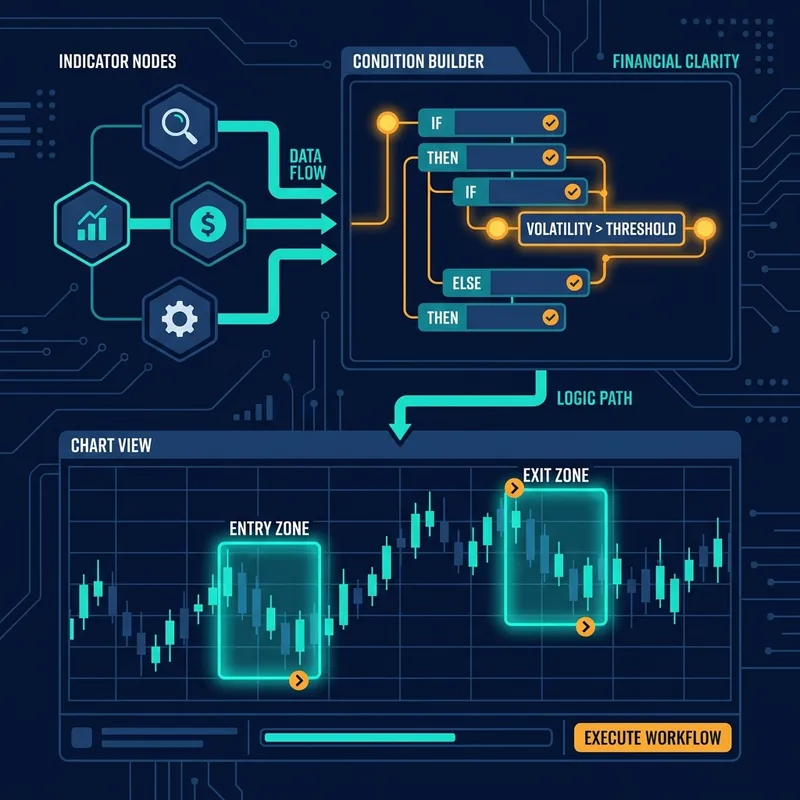
The workflow for paper-trading an automated strategy is more structured than manual paper trading. It starts before you open a single simulated position.
1. Define your conditions explicitly. Every entry condition, exit condition, and stop-loss rule needs to be written out in precise, testable terms before the simulation starts. "Buy when momentum is strong" is not a condition. "Enter long when the 9-period EMA crosses above the 21-period EMA and volume exceeds the 20-period average" is.
2. Build the strategy in a no-code environment. A no-code strategy builder lets you construct this logic visually — connecting indicators, setting thresholds, defining the sequence of conditions — without writing code. The logic is explicit and auditable, which matters when you're trying to verify that the strategy is doing what you intended.
3. Run the simulation and watch where rules trigger on the chart. This is the step most paper trading guides skip entirely. For algo traders, it's the most important one. Seeing exactly where your entry conditions and exit conditions fire on the chart — not just in a trade log — lets you verify the logic visually. If the entry is triggering in the middle of a candle rather than at the open, or the stop-loss is firing before price actually reaches your level, you'll see it immediately.
Quberas's visual debugger and deal map interface are built specifically for this: the platform highlights chart zones tied to each condition, so you can trace exactly why a trade opened or closed at a specific point. Nested logic conditions — where multiple indicators must align simultaneously — are particularly hard to verify from a trade log alone. Visual confirmation on the chart makes the debugging process concrete.
4. Review the results against your intent. Did the strategy trigger where you expected? Did the exits fire correctly? Were there trades that shouldn't have opened? This review loop — simulate, observe, adjust, re-simulate — is how a paper-traded algo strategy gets refined before going live.
Best Paper Trading Platforms and Apps
Broker and Charting Platforms (Manual Practice Focus)
Several major brokers and charting platforms offer paper trading accounts as part of their standard environment. Interactive Brokers is widely known for offering a paper trading mode — verify the current feature set and supported instruments directly on their site, as platform capabilities can change. TradingView is a popular charting platform that many traders use for technical analysis; check their current documentation for any paper trading or simulation features they may offer. Webull is another platform retail traders commonly use for simulated trading — confirm its current availability and feature set before committing.
For futures trading simulator needs, several dedicated futures platforms offer sim modes — verify availability with the specific platform you're evaluating. Options trading simulator functionality is available through a range of options-focused brokers. Paper trading forex is widely supported among retail forex brokers, with demo accounts a common offering — confirm the data quality and order types supported before committing to one.
What to look for in any paper trading platform: real-time data quality (delayed data produces unrealistic results), realistic order execution modeling, and a clean trade log you can actually review.
No-Code Algo Strategy Simulators (Automated Strategy Focus)
Broker-based paper trading accounts are built for manual order placement. They don't help you verify whether your strategy's logic is implemented correctly — they just let you place orders by hand in a simulated environment.
For crypto paper trading and algo strategy validation, you need a platform that lets you define the rules of your strategy, run them against real market data, and see where those rules trigger. Logic visibility and debuggability — the ability to inspect why a specific trade opened or closed — are the features that matter here, not just a virtual balance.
This is the gap that a no-code algo strategy paper trading tool fills. Rather than placing trades manually, you define the conditions, let the platform execute them, and review the chart triggers to confirm the logic is working as intended.
How to Get Started with a Paper Trading Account
1. Choose the right platform for your goal. If you're practicing manual execution, a broker demo account works fine. If you're validating an automated strategy, you need a platform that supports rule-based simulation with visual feedback on where conditions trigger.
2. Set a realistic virtual starting balance. Match it to what you'd actually deploy live. If you're planning to start with $5,000, don't paper trade with a figure ten times larger — the position sizing, risk per trade, and psychological reference points will all be off.
3. Define your strategy rules before you start. This is non-negotiable for algo traders. The simulation should be testing a defined system, not a series of ad hoc decisions. Write out every entry condition, exit condition, and stop-loss rule before the first simulated trade opens.
4. Run the simulation with real-time data over a meaningful period — at minimum a few weeks, ideally across different market conditions (trending, ranging, high-volatility). A strategy that only works in one market regime is fragile.
5. Review trade logs and chart triggers after each session. Don't just look at total P&L. Examine individual trades: why did this one open? Why did that one close early? The goal is to understand the strategy's behavior, not just its aggregate outcome.
6. Decide when results are sufficient to go live. Look for consistency across a meaningful sample, not a handful of winning trades. Factor in that live performance will likely be slightly worse than paper performance due to slippage and execution differences.
For algo traders starting from scratch, Quberas provides the no-code environment to define conditions, simulate them visually, and review exactly where the logic fires on the chart — before any real capital is involved.
Common Mistakes to Avoid When Paper Trading
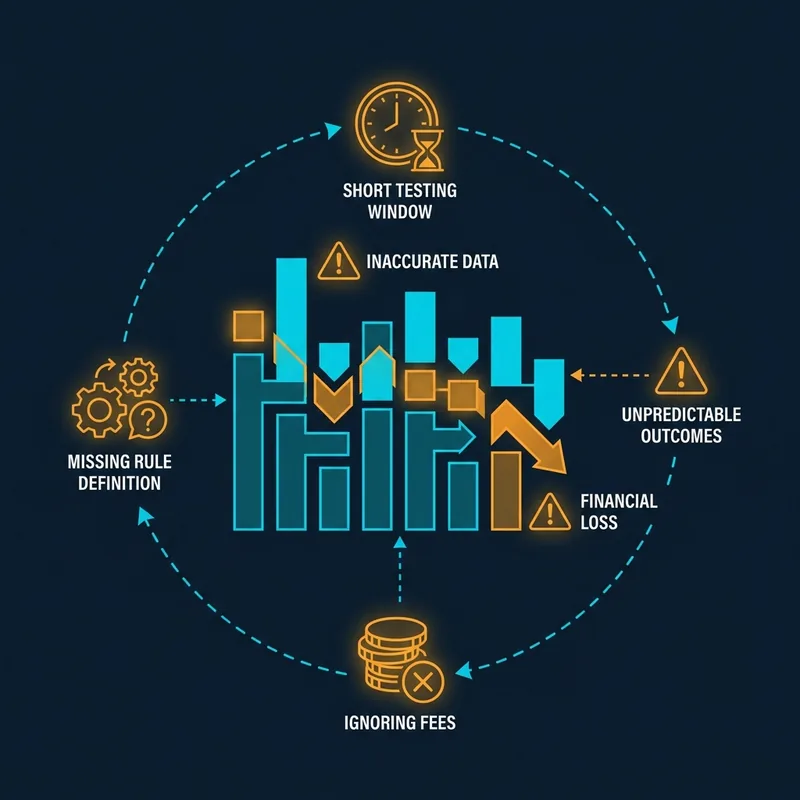
Treating paper results as guaranteed live results. They're not. Paper trading removes slippage, emotional pressure, and often liquidity constraints. Use paper results to validate logic, not to project exact returns — live performance will typically fall short of what simulation shows.
Skipping the paper phase entirely. Some traders backtest a strategy, see positive results, and go straight to live trading. Backtesting confirms historical fit; it doesn't confirm correct implementation. Paper trading is the step that catches logic errors before they cost real money.
Not defining rules before starting. If you're making discretionary decisions during a paper trading session, you're not testing a strategy — you're practicing manual trading. For algo validation, every rule must be defined upfront.
Ignoring slippage and fees in simulation. If your platform doesn't model trading fees, account for them manually when evaluating results. Even modest per-trade costs compound quickly across a high-frequency strategy, and ignoring them produces an unrealistically clean P&L picture.
Paper trading too short a time window. A two-week paper trading period that happens to coincide with a strong trend tells you almost nothing about how the strategy performs in a ranging or reversing market. Run the simulation long enough to encounter varied conditions.
Not reviewing why individual trades triggered. Total P&L is a summary metric. The real value of paper trading is understanding the behavior of your rules at the trade level — which conditions fired, in what sequence, and whether that matches your intent.
Switching strategies too quickly based on paper results. A strategy that has a losing week during paper trading isn't necessarily broken. Evaluate performance over a statistically meaningful sample before making changes. Frequent strategy-switching based on short-term paper results produces no useful signal.
Ready to paper-trade your own algo strategy? Build your first no-code bot in Quberas and see exactly where your rules trigger on the chart — before you risk a single dollar live.