Autotrader Bot: Build, Backtest & Launch Without Code
Automating a trading strategy without writing a single line of code is genuinely possible — but only if you understand what an autotrader bot actually does, where the real risk lives, and how to verify your logic before any real money moves. This guide walks through the mechanics, the honest performance picture, and a practical workflow for building and backtesting a bot using a visual, no-code approach.
What Is an Autotrader Bot and How Does It Work
An automated trading bot is software that monitors market data and executes trades according to a predefined algorithmic trading strategy — a set of rules that specify exactly when to enter a position, how to manage it, and when to exit. The bot replaces manual order placement, but it does not replace the strategy. That part is still entirely yours.
The Core Execution Loop: Signal, Condition, Order
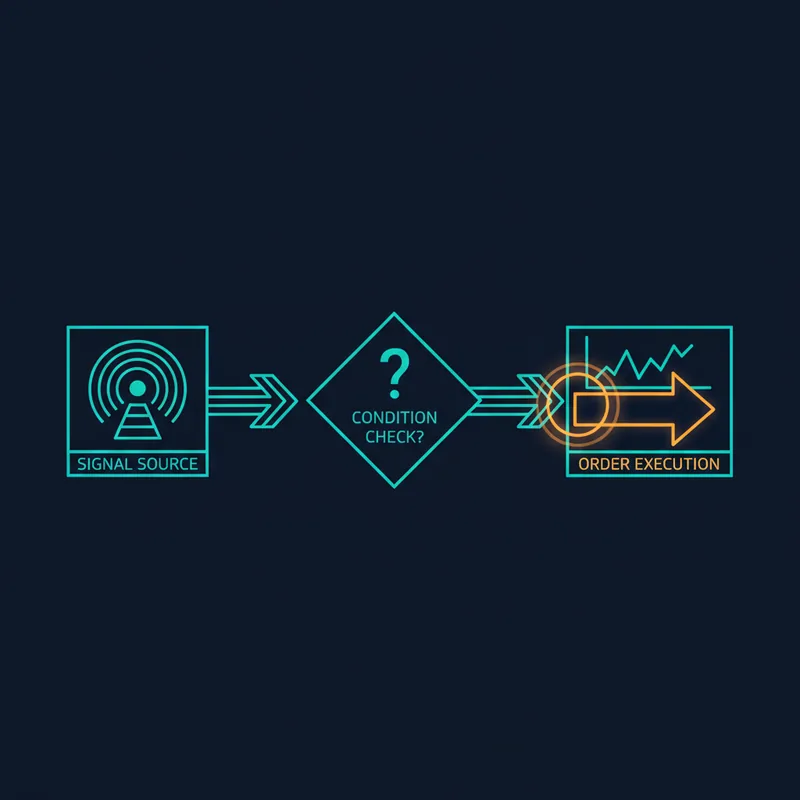
Every bot, regardless of platform, runs the same fundamental loop:
- Signal — the bot reads live market data: price, volume, indicator values, or a combination.
- Condition check — it tests that data against your defined entry and exit conditions (e.g., RSI crosses below 30 while price is above the 200-period moving average).
- Order — if conditions are met, the bot sends an order to the exchange. If not, it waits and loops again.
This is meaningfully different from a signal service, which only alerts you to act. A bot acts autonomously once conditions are satisfied — which is both its power and its risk.
How Bots Connect to Crypto and Forex Exchanges
Bots typically connect to exchanges through an API connection (Application Programming Interface) — an interface the exchange provides so third-party software can read market data and submit orders on your behalf. You generate an API key in your exchange account, set its permissions (typically read + trade, never withdrawal), and configure it in the bot platform. The bot never holds your funds; it only instructs the exchange to move them. This applies to crypto markets and forex markets alike, though the specific exchanges and brokers that support API access vary — always confirm your platform is compatible before building a strategy around it.

Are Autotrader Bots Legal and Safe to Use
Automated trading is permitted on many retail exchanges and brokers that offer API access — the API is provided specifically to enable programmatic trading. That said, regulatory requirements differ by jurisdiction and platform, and it is your responsibility to confirm that automated trading is allowed under the rules of your specific broker, exchange, and local regulations before going live.
Safety is a separate question, and it has two layers:

API security — never grant withdrawal permissions to a bot's API key. Use IP whitelisting where the exchange supports it. A compromised key with trade-only permissions can place bad orders; a key with withdrawal access can drain your account entirely.
Platform legitimacy — the biggest red flag in this space is any platform promising guaranteed returns or hiding how its logic works. Legitimate automation tools give you full visibility into what the bot will do. If a platform cannot show you the exact conditions that trigger a trade, treat it as a black box and walk away. Established exchanges with published API documentation are generally safer integration points than obscure or unregulated alternatives.
Risk management as a safety layer means building hard limits into the strategy itself: maximum position size, stop-loss rules, and daily loss caps. These are not optional refinements — they are the difference between a bad week and an account-ending event.
Do Autotrader Bots Actually Make Money?
Some do. Most don't — not because bots are inherently flawed, but because the strategies running inside them are flawed, untested, or applied in the wrong market conditions.
Why Strategy Logic — Not the Bot — Determines Results
A bot is an execution engine. It will follow your rules perfectly, which means a bad strategy runs perfectly badly. The metrics that matter are not about the bot — they are about the strategy:
- Win rate — the percentage of trades that close profitably. A 40% win rate can still be profitable if winners are significantly larger than losers.
- Drawdown — the peak-to-trough decline in account equity during a losing streak. Maximum drawdown is a more honest measure of real risk than win rate alone.
- Profit factor — a commonly used measure of how much a strategy earned relative to what it lost over a sample of trades. A higher profit factor over a meaningful number of trades is generally considered a sign of a strategy with genuine edge; a low or negative profit factor suggests the strategy was not net profitable over the test period.
Rule-based strategies tend to perform well in trending or range-bound markets where the conditions they were built for repeat. They break down in choppy, low-volume, or structurally shifting markets — which is why no strategy works indefinitely without review.
The Transparency Problem with Black-Box Automation
Many popular bot platforms hide their logic behind preset templates or proprietary signals. You can see the result — a trade opened or closed — but not the exact condition that triggered it. This makes improvement nearly impossible: if you don't know why a trade fired, you can't refine the rule that caused it. Backtesting (running your strategy against historical data) becomes meaningless if you can't verify which conditions actually triggered each trade. Transparency is not a nice-to-have; it's the prerequisite for improving a strategy over time.
Three Approaches to Autotrader Bot Platforms
Autotrader bot platforms differ significantly in how much logic control they give you. Three broad patterns appear across the market — though individual platforms may blend elements of more than one.
Code-Based Bots: Maximum Flexibility, High Barrier
Writing your own bot — in Python, for example, or using a broker's scripting environment like MetaTrader Expert Advisors — gives you complete control over logic. You can implement any indicator, any order type, any execution nuance. The barrier is real: you need programming competence, debugging skills, and the time to maintain code as APIs change. This suits developers who want to build proprietary systems — not traders whose edge is in market knowledge, not software engineering.
Parameter-Buried Platforms: Easy Setup, Limited Visibility
These platforms offer pre-built templates where you adjust a handful of parameters — an RSI period, a take-profit percentage — without seeing the full logic underneath. Setup is fast, but you're constrained to what the template allows. Adding a volume filter, combining two indicator conditions, or understanding exactly when the bot will and won't trade is often not possible. Iteration is slow because the logic isn't yours to inspect.
Visual No-Code Builders: Full Logic Control Without Programming
A no-code strategy builder lets you construct entry and exit logic by connecting conditions visually — no syntax, no compiler. The best implementations show you exactly where those conditions triggered on a historical chart, so you can verify the logic is doing what you intended before going live. This approach suits traders who have a clear strategy in mind and want to systematize it without outsourcing the logic to a template or a developer.

How to Build an Autotrader Bot Without Coding
The workflow below reflects how a visual, drag-and-drop builder structures the process. The concepts apply across platforms; the visual tools make each step inspectable.
Step 1: Define Your Entry Conditions
Start with the specific market state that should open a position. A condition builder lets you combine various signal types — price levels, indicator values (such as RSI, MACD, or Bollinger Bands), volume thresholds, crossovers between indicators, and combinations of these using AND/OR logic. The list of what any given platform supports will vary, so check your platform's documentation for the full set. The more precisely you define the entry, the fewer false signals the bot generates. Vague conditions produce noisy entries; specific, combined conditions narrow the trigger to the market state you actually want.
Step 2: Set Exit Rules and Stop-Loss Logic
Every position needs a defined exit — both for profit and for loss. Set:
- Take-profit targets — fixed price, percentage gain, or indicator-based exit
- Stop-loss rules — the maximum loss you'll accept per trade, expressed as a price level or percentage
- Averaging orders — additional entries at lower prices to reduce average cost, with defined size and spacing
Stop-loss placement is not optional. A bot without a stop-loss will hold a losing position indefinitely if the exit condition never triggers.
Step 3: Review Your Logic on the Chart Before Testing
A visual deal map — the drag-and-drop interface that connects your conditions into a complete strategy — should render directly onto the price chart. Before running any backtest, scroll through historical data and confirm that the conditions you defined are triggering where you expect: at the right price levels, in the right market context. If the entry fires in the middle of a ranging market when you built it for a breakout, the logic needs revision, not more testing. Quberas is built around exactly this step — seeing rule triggers on the chart before committing to a backtest or live deployment.
How to Backtest Your Bot Before Going Live
Backtesting means running your strategy against historical market data to see how it would have performed. It is non-negotiable before live deployment — not because past performance predicts future results, but because it reveals whether your logic is coherent and whether the strategy has ever had an edge.
What Backtest Metrics Actually Tell You
Evaluate results across at least these three dimensions:
- Win rate — useful context, but not the primary metric
- Max drawdown — how deep did the equity curve fall? If it exceeds what you could tolerate emotionally or financially, the strategy needs adjustment
- Profit factor — a measure of gross profit relative to gross loss over the test period; a higher ratio over a large sample of trades is generally taken as a sign of genuine edge
Watch for overfitting — tuning parameters so precisely to historical data that the strategy performs perfectly on the past and fails on new data. Signs include very high win rates on short historical windows, oddly specific parameter values that only work on one date range, and performance that collapses the moment you test a different period.
Visual Backtesting: Seeing Exactly Where Your Rules Fired

A visual backtest overlays entry and exit markers directly on the chart, tied to the conditions that triggered them. This lets you spot immediately whether the bot entered during the conditions you intended — or whether it fired on noise. Paper trading (forward testing on live data without real money) is the logical next step after a backtest: it confirms the strategy behaves as expected in real market conditions before capital is at risk.
What to Look for in the Best Autotrader Bot Platform
Use these criteria to evaluate any platform, including free tiers:
- Strategy transparency — can you see the exact conditions that will trigger every trade, before it happens?
- Backtesting quality — does the platform show you where rules fired on the chart, or just a summary P&L?
- Logic control — can you combine multiple conditions with AND/OR nesting, or are you limited to single-parameter templates?
- Exchange and market coverage — does it support the crypto exchanges or forex brokers you already use?
- Risk management controls — are stop-loss, position sizing, and daily loss limits built into the strategy layer, not just account settings?
- Free tier or trial — a platform confident in its product offers a way to build and backtest before you pay. Use it to test the interface against a real strategy before committing.
- Iteration speed — how quickly can you adjust a condition and re-run a backtest? Slow iteration cycles kill the refinement process.
Frequently Asked Questions About Autotrader Bots
Are auto trading bots any good? They are as good as the strategy inside them. A bot running a well-defined, backtested strategy with clear risk rules can execute more consistently than manual trading — no hesitation, no emotional deviation. A bot running a vague or untested strategy will lose money more efficiently than you would manually.
Is there a trading bot that actually works? Yes — but "works" means the strategy works, not the bot. Traders who see consistent results from automation typically have a specific, rules-based strategy they've refined over time, tested against historical data, and deployed with strict risk controls. There is no bot that generates returns without a sound underlying strategy.
Can I use an autotrader bot for free? Most serious platforms offer a free tier or trial period. Use it to build and backtest a real strategy — not just to click around the interface. If a platform charges before you can verify how the bot behaves, that's a red flag.
Do I need to know how to code? Not with a visual no-code builder. The condition builder and deal map replace code with a visual interface — you define logic by connecting conditions, not by writing syntax. The strategy is still entirely yours; you're just not writing it in Python.
What markets can autotrader bots trade — crypto and forex? Both. Crypto bots connect via exchange APIs, and forex bots typically connect through broker APIs or compatible trading platform integrations. The underlying logic-building process is the same; the exchange connection and available instruments differ by platform. Always verify that your chosen bot platform supports the specific exchange or broker you intend to use.
Ready to build your first autotrader bot and see exactly how it works on the chart? Start with Quberas — no coding required.