Forex Scalping Trading Strategy: Build & Backtest
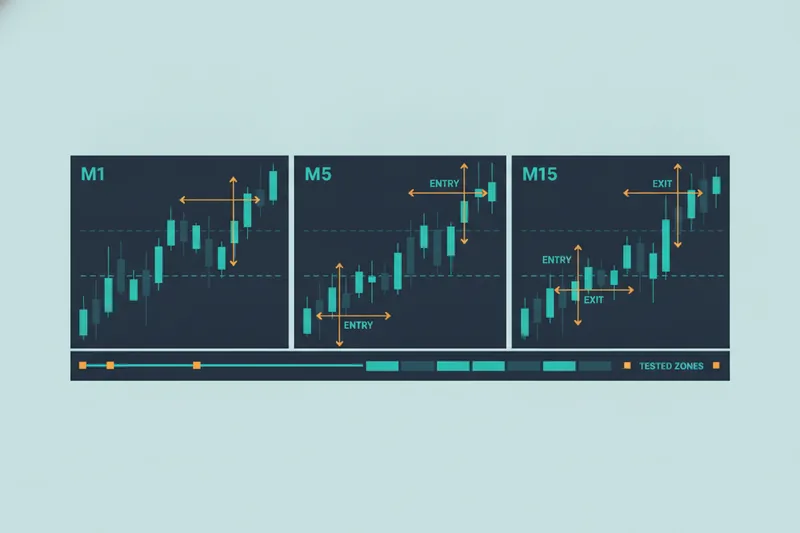
A forex scalping trading strategy is a rule-based system for opening and closing many trades within minutes, aiming to capture small price movements on M1, M5, or M15 charts rather than riding a larger trend. What separates a strategy that actually holds up from a list of scalping "rules" copied off a broker's education page is proof: you need to know your entry and exit conditions actually trigger the way you think they do, and that they would have performed well on real historical price data before you risk capital on them. This guide builds that strategy piece by piece — indicators, timeframe choice, entry/exit logic, risk controls, session timing — then shows how to validate it with backtesting and a visual debugger instead of taking it on faith.
What Is Forex Scalping?
Forex scalping is a trading style built around very short holding periods — typically seconds to a few minutes — where a trader opens dozens of small trades a day to capture tiny price movements rather than a handful of larger swing trades. It's usually executed on the M1, M5, or M15 timeframes (1-minute, 5-minute, and 15-minute charts), with outcomes shaped less by big directional moves and more by execution quality, spread, and timing.
Three mechanics matter more here than in any other trading style. The spread — the gap between the bid and ask price — eats directly into a scalp's tiny profit target, so a strategy that looks fine on paper can be unprofitable once spread is subtracted from every trade. Liquidity, the volume of buyers and sellers available at a given price, determines how cleanly your orders fill; thin liquidity widens spreads and slows fills exactly when you need speed. Slippage is the difference between the price you requested and the price you actually got — a few points of slippage on a strategy targeting 5-10 points can turn a winning system into a losing one. Scalping isn't the only short-term approach to the market — day trading also covers range, trend, gap, and breakout strategies — but scalping is the one where these three variables decide whether a mechanically sound rule set is actually tradable. Seeing exactly where a rule would have triggered, rather than assuming it, is the part most scalping guides skip; it's the reason tools like Quberas let you build the logic as a visual map and check it against the chart before committing money to it.
How Does a Scalping Strategy Work?
A scalping strategy works by converting a market observation into a mechanical, repeatable rule: when condition A and condition B are both true on the chart, enter; when condition C is true, exit. There's no discretionary "it feels like it's about to move" — every entry and exit is a rule-based trigger tied to price, an indicator value, or volume crossing a defined threshold.
Because trades are held for minutes rather than hours, a scalping strategy runs at high trade frequency — often 20 to 50+ setups a day on a liquid pair. That frequency is what makes precision non-negotiable: on a 4-hour chart, being a pip or two off on your entry barely registers against a 200-pip move. On a 1-minute chart, a pip or two is often the entire expected profit. Every condition needs to be defined tightly enough that it fires at a consistent, chart-verifiable point — not "when RSI is low" but "when RSI crosses below 30 on the same candle the price closes below the lower Bollinger Band." That specificity is what turns a scalping idea into a strategy you can actually test.
Best Indicators for Forex Scalping
Scalping strategies are usually built from a small set of fast-reacting indicators, combined so that one confirms the other rather than trading off a single signal.
- EMA (Exponential Moving Average): weights recent price more heavily than older price, so it reacts faster than a simple moving average. A fast EMA (e.g., 9-period) crossing above a slower EMA (e.g., 21-period) is a common trend-direction filter for scalpers.
- RSI (Relative Strength Index): measures the speed and magnitude of recent price moves on a 0-100 scale. Scalpers watch for RSI crossing above 30 (exiting oversold) or below 70 (exiting overbought) as a momentum-shift trigger.
- Stochastic Oscillator: compares a closing price to its recent price range, and is more sensitive than RSI on short timeframes — useful for catching quick reversals, though also more prone to false signals.
- Bollinger Bands: plot volatility bands around a moving average. Price touching or piercing the outer band, then closing back inside it, is a common scalping entry for mean-reversion setups.
Crossovers — a fast line crossing a slow line, or price crossing a band — are the mechanical backbone of most scalping entries because they give a precise, timestamped trigger point rather than a subjective read of the chart. Most working scalping strategies pair a trend filter (EMA) with a momentum or volatility confirmation (RSI, Stochastic, or Bollinger Bands) rather than trading any single indicator alone.
1-Minute vs 5-Minute Scalping Strategies
The choice between a 1-minute scalping strategy and a 5-minute scalping strategy is a direct trade-off between trade frequency and signal reliability. On M1, price action is dominated by noise — small, random fluctuations that don't reflect a genuine shift in supply or demand — so a fast EMA crossover or RSI dip can fire several times in a few minutes without any real follow-through. That means more trading opportunities, but also a higher rate of false signals and a much heavier dependence on tight spreads and fast execution, since profit targets are smaller.
M5 filters out a portion of that noise. Candles aggregate more price action, so a crossover or band touch on M5 tends to reflect a more meaningful move, and the strategy needs fewer, more selective trades to reach the same daily profit target. The cost is fewer setups per session and slightly wider stop-losses relative to the smaller pip targets of M1. Traders newer to scalping generally get more consistent, testable results starting on M5 and moving to M1 once the logic is validated — there's less room for execution error to swamp a legitimate signal.
Building a Step-by-Step Scalping Strategy: Entry, Exit, Stop-Loss
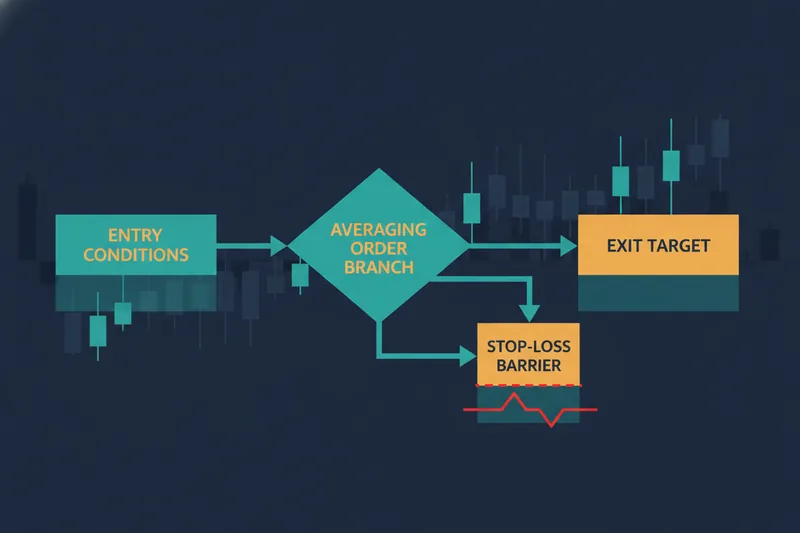
Once you've chosen a timeframe and an indicator set, the strategy needs to be expressed as an explicit sequence: entry conditions, what happens if price moves against you before target, the exit, and the stop-loss. This is naturally a multi-stage flow rather than a single if-then rule, which is why it's easier to manage as a visual deal map — a diagram of each stage (entry, averaging, exit, stop-loss) and how they connect — than as a paragraph of rules you have to hold in your head.
Defining Entry Conditions
A workable entry condition for a scalp combines a trend filter with a trigger: for example, price above the 21 EMA (trend filter) AND RSI crossing above 30 from below (momentum trigger) AND the candle closing above the previous candle's high (confirmation). A puzzle-style condition builder lets you assemble this kind of nested logic — price, indicator, and volume conditions joined with AND/OR — without writing code, and see it rendered as connected blocks rather than a script.
Some scalpers add an averaging order: if price moves slightly against the initial entry without hitting the stop, a second order is added at a better price to improve the average entry. This is distinct from a DCA (dollar-cost-averaging) bot, which buys or sells at fixed intervals regardless of price rather than adding on when a position moves against you — an averaging order is a risk-defined, conditional add, not a scheduled one.
Setting Exit and Stop-Loss Rules
The exit rule should be as mechanically defined as the entry — a fixed pip target, a trailing stop once price moves a set distance in your favor, or an opposing indicator signal (e.g., RSI crossing back below 70). The stop-loss placement should sit beyond a structural point — the recent swing low/high or outside the Bollinger Band — rather than an arbitrary pip count, so it isn't triggered by normal noise on the timeframe you chose above. Mapped visually, entry, averaging, exit, and stop-loss become stages you can inspect and adjust individually rather than a single fragile rule.
Risk Management for Scalpers
Scalping's trade frequency means a small risk-management mistake compounds fast — one oversized loss can wipe out a day of small wins. The risk-reward ratio (potential profit vs. potential loss on a trade) needs to be evaluated per setup; because scalping targets are small, even a 1:1 ratio can be profitable if win rate is high enough, but it leaves no room for slippage or spread costs to erode the edge.
Position sizing — how much capital is risked per trade — should be fixed as a small percentage of account equity rather than a flat lot size, so a losing streak doesn't scale with your account balance the wrong way. One commonly cited framework, the 3-5-7 rule, caps risk at 3% per trade and 5% across all open positions simultaneously, with a minimum 7% profit-to-loss expectation — useful as a reference point for scalpers deciding how tight their own limits should be. Stop-loss discipline means never moving a stop further away once it's placed; on short timeframes, one undisciplined exception can offset a dozen correctly managed trades. Enforcing a loss limit and a cooldown period after a stop-loss hit — pausing the strategy for a set time or number of candles before it can re-enter — helps prevent revenge trading from compounding a bad session into a bad week.
Best Trading Sessions and Execution Requirements for Scalping
Scalping performance depends heavily on when you trade. The London/New York session overlap (roughly 8am-12pm EST) is generally the best window for scalping because it combines the highest liquidity and tightest spreads of the trading day. Outside peak sessions — the late New York close through the early Asian session, for example — spreads widen and liquidity thins, which directly undermines a strategy built around small pip targets.
Execution infrastructure matters as much as timing. Broker execution speed — how quickly an order is filled after you send it — determines how much slippage you absorb on entries and exits; a broker with slow execution can turn a validated strategy into a losing one in live conditions. Some brokers also apply a mark-up on top of the raw spread, which further compresses the margin a scalp is working with. Reliable execution generally rests on three components: a trading platform that can place orders quickly, a live data feed accurate enough to trigger conditions on time, and analytics or journaling to review what actually happened afterward. Running a strategy unattended around the clock doesn't strictly require dedicated server hosting — a home PC is fine for testing — but for live trading, the risk of a dropped connection or a crashed machine mid-trade makes a VPS (virtual private server) worth considering for real-money use, and low-cost VPS hosting is widely available for a few dollars a month.
Backtesting and Optimizing a Scalping Strategy
A strategy built from sound indicators and disciplined risk rules is still an assumption until it's tested against real data. Backtesting a scalping strategy means running your entry, exit, and stop-loss rules against historical price data to see how they would have performed — not whether they feel right. Because scalping decisions depend on fine price detail, testing should use granular OHLCV data (open, high, low, close, volume) at minimum, and ideally bid/ask or order-book-derived data, since spread and fill quality matter more here than on longer timeframes.
A useful backtest reports more than a profit number: win rate, maximum drawdown (the largest peak-to-trough equity decline), and — just as important for scalping — the false-signal rate, how often a condition fired without producing a real move. Backtesting alone isn't the finish line, either; forward testing the same rules on live-but-unfunded conditions is treated as an equally necessary step before trading real capital, not an optional extra.
This is where a visual debugger earns its keep. Rather than trusting that a condition "should have" triggered, it highlights the exact chart zones tied to each rule, so you can see precisely where a trade fired — and, just as usefully, where a condition came close but didn't cross the threshold ("almost triggered" vs. "triggered"). Reviewing those near-misses is how you tune thresholds: if RSI at 32 keeps almost triggering and producing weak follow-through, tightening the trigger to 28 can cut noise-driven entries without needing to guess at the right number.
From Manual Scalping to Automated Algo Bots
Once a strategy has held up in backtesting and forward testing, the case for automation is mostly about speed: an algorithmic scalping bot executes the instant a condition is met, with no delay for a human to notice the setup, confirm it, and click. On a timeframe where a two-second delay can be the difference between the entry price you wanted and one three pips worse, that execution-speed advantage is the whole point of automating a scalp rather than trading it manually.
Tools that let you build this kind of automation without programming have become far more accessible — capability that used to sit mainly with institutional desks is now available to retail traders through no-code strategy builder platforms. Some automation platforms still require scripting to define or adjust rules; a no-code builder instead lets the same entry, exit, and stop-loss logic you mapped out and backtested earlier be launched directly as a live bot, with the visual deal map staying as the reference for exactly what the bot will do once it's running.
Pros, Cons and Common Mistakes in Forex Scalping
Scalping's main advantage is that it doesn't require a strong directional market view — you can generate opportunities in ranging or choppy conditions where swing traders find nothing to do. Its cost is that it demands tight execution, low spreads, and constant attention (or automation) to be worth doing at all; a strategy that's profitable on paper can lose money once realistic spread and slippage are applied.
Common scalping mistakes cluster around a few habits. Overtrading — taking marginal setups just to stay active — is the fastest way to erode an edge through spread costs alone. Ignoring spread costs when backtesting or evaluating a strategy is a related error: a rule set that looks profitable on clean historical data can be unprofitable once real spread is subtracted from every trade. Moving a stop-loss further away "to give it room" rather than accepting the loss is another habit that turns small, planned losses into large, unplanned ones.
Is 1-minute scalping good? It can work, but it's less forgiving of noise, execution delay, and spread than 5-minute scalping, and it punishes an untested strategy faster. Can scalping make consistent money? Only as a rule-based, tested system with real risk controls — not as a set of generic entry rules applied by feel, which is the gap between most scalping guides and a strategy that actually holds up in live conditions.
Build this scalping strategy as a visual deal map in Quberas, backtest it on historical data, and see exactly where it triggers before you risk real capital.