What Is an Algo Bot? How They Actually Work

Every algo bot is really just a rule-follower: it reads market data, checks that data against conditions a trader has set, and places or closes trades the moment those conditions are true — nothing more mystical than an if-this-then-that machine running on price and indicator data instead of guesswork. Whether it's built by a hedge fund quant or a retail trader using a visual tool, that's the entire mechanism underneath the term "algo bot." This guide breaks down how that mechanism actually works, where it differs across crypto, stocks, and forex, how no-code building compares to hand-coded development, and — honestly — whether any of it reliably makes money.
What Is an Algo Bot? (Definition & Core Concept)
An algo bot (short for algorithmic trading bot) is a piece of software that executes trades automatically based on a predefined set of rules, rather than a human clicking "buy" or "sell" in the moment. It's the practical output of algorithmic trading — using a coded or visually defined logic to decide when, what, and how much to trade.
A trading bot needs three ingredients to function: market data (price, volume, order book), a rule set that interprets that data, and a connection to a broker or exchange that can execute the resulting order. The rule set is what people mean when they talk about an automated trading strategy — a structured sequence of conditions like "if the 50-period moving average crosses above the 200-period moving average, buy" or "if price drops 3% below entry, sell."
Those conditions are usually built from technical indicators — mathematical calculations derived from price and volume, such as moving averages, RSI, or MACD — that translate raw price movement into readable signals. When an indicator's value crosses a defined threshold, it produces a trading signal: a specific, timestamped instruction the bot can act on. This is also where the legitimacy question that first-time researchers usually have starts to matter — a bot is only as trustworthy as the visibility into why it fired a signal, which is the core problem tools like Quberas were built to solve by letting traders see each condition evaluated directly against the chart rather than trusting a black box.
How Do Algo Trading Bots Work?
From indicator to signal to executed trade
The mechanism has a consistent shape regardless of platform. First, the bot pulls in live or historical market data. Second, it evaluates that data against the trader's defined entry and exit conditions — the rules that say when to open a position and when to close it. Third, once a condition is met, the bot generates a trading signal. Fourth, that signal triggers automated execution: an order sent to the exchange or broker with no manual click required.
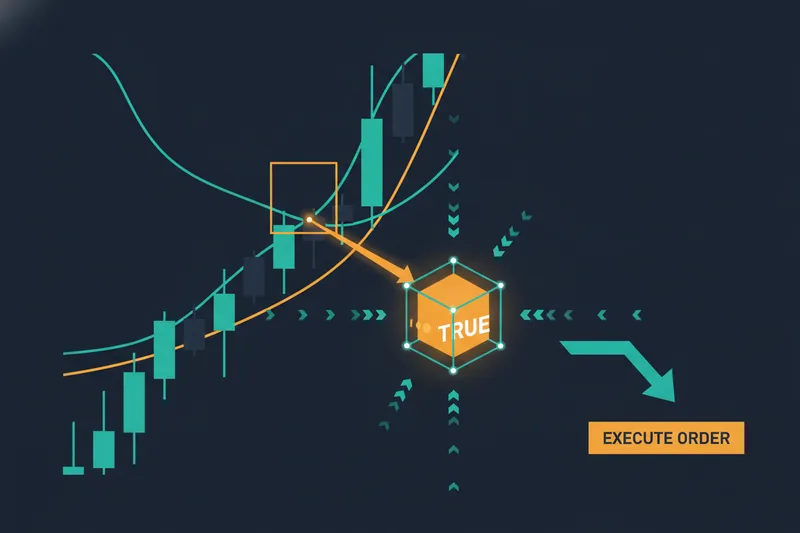
A stop-loss sits alongside entry and exit logic as a protective condition — a price level at which the bot automatically closes a losing position to cap the damage rather than letting it run. Most real strategies aren't single conditions but layered ones: an entry rule combined with an exit rule, a stop-loss, and sometimes conditions for adding to a position. The bot doesn't "decide" anything in a human sense; it continuously checks whether the combined rule set is satisfied and acts the instant it is.
Why rule transparency matters when a bot triggers
The practical risk in algo trading isn't usually the concept — it's not knowing exactly why a bot entered or exited a trade. A strategy that triggers on a condition buried three layers deep in code is hard to debug when it behaves unexpectedly, and harder still to trust with real capital. This is why visual, rule-by-rule inspection — seeing which condition fired, at what price, on which candle — matters more in practice than the sophistication of the indicators themselves. A trader who can point to the exact chart zone that caused a trade can also identify false signals and fix them; one who can't is stuck guessing.
Types of Algo Bots: Crypto, Stocks, and Forex
Algo bots follow the same core mechanism across markets, but the conditions that make sense differ with each market's behavior.
A crypto trading bot typically operates in a market that never closes, with higher volatility and thinner liquidity on smaller pairs than major stocks or currencies. This is also where averaging-style bots are common — though it's worth distinguishing two mechanisms that get conflated: a true dollar-cost-averaging (DCA) bot buys or sells at fixed time intervals regardless of price, while a price-based averaging strategy adds to a position only when price moves against it by a set amount. They produce very different risk profiles even though both get casually called "DCA."
A stock trading bot works within defined market hours and typically deals with more regulated, less volatile instruments than crypto, which usually allows for wider stop-loss and take-profit distances relative to price. Many stock-focused platforms are also built around a broader toolset than just execution — combining an order-execution layer, a market data feed, and analytics or journaling tools to review performance after the fact, since evaluating a stock strategy properly means more than just watching the trade log.
A forex algo bot most often runs on infrastructure historically tied to MetaTrader, where automated strategies are packaged as Expert Advisors (EAs). It's worth knowing that not every EA automates trading — some are used purely for chart analysis or display, with a separate EA handling actual order execution. Forex also trades nearly 24/5 with heavy influence from session overlaps (London, New York, Tokyo), so time-of-day conditions matter more here than in crypto or stocks.
No-Code vs. Coding Your Own Algo Bot
What a no-code visual builder lets you see and adjust
A no-code strategy builder replaces scripting with a visual condition builder: you select indicators, set thresholds, and connect them into entry, exit, and stop-loss logic using a drag-and-drop interface instead of writing functions. The advantage isn't just accessibility for non-programmers — it's iteration speed. Changing a threshold or adding a nested condition is a few clicks, and the effect is visible immediately against the chart rather than requiring a script re-run and manual log inspection.
When coding your own bot still makes sense
Coding-based bots still have a real place, particularly for strategies that need custom data sources, unusual order types, or integration with infrastructure a visual tool doesn't expose — some platforms, like AlgoBuilder, are built specifically around Python-based strategy development for exactly this kind of flexibility. The trade-off is time and transparency: a coded strategy takes longer to build and modify, and its logic isn't visible in the trading interface unless the developer builds separate tooling to expose it. For traders who want to test and refine strategies quickly, without maintaining code, and who want the trigger logic visible on the chart rather than buried in a script, a visual approach is generally the faster path to a working, inspectable strategy.
Backtesting and Risk Management for Algo Bots
Backtesting runs a strategy's rules against historical price data to see how it would have performed, before any real money is at risk. It's a necessary step, but not a sufficient one on its own — backtesting and forward testing (running the strategy on live, unseen data without committing real capital) are both required stages before a strategy should be trusted with real funds; neither replaces the other. A strategy that looks strong on historical data can still fail in forward testing if market conditions have shifted.
Risk management in an algo bot usually operates at two levels: the individual trade and the overall exposure. At the trade level, a stop-loss and averaging orders (adding to a position under defined conditions, distinct from time-based DCA as noted earlier) control how much a single trade can lose or how it's built up. At the portfolio level, disciplined traders often cap risk with rules like the 3-5-7 approach: no more than 3% risked on a single trade, no more than 5% risked across all open positions at once, and a minimum 7% profit-to-loss ratio to keep winners outweighing losers.
One infrastructure detail worth knowing before going live: a bot doesn't need a dedicated server to be backtested or even paper-traded — a home computer is fine for that. But running a strategy continuously with real capital exposes it to the failure modes of home internet and power outages, which is why a VPS (a remote server that keeps the bot running independent of your own machine) becomes practically necessary once a strategy graduates from testing to live trading.
Is Algo Trading Profitable? Common Risks and Misconceptions
Is algo trading real or fake?
Algo trading is real in the sense that the mechanism is exactly what's described above — rules evaluated against data, executing automatically. It's not inherently a scam, and the tools have genuinely expanded: AI-assisted and automated trading tools once limited to institutional desks are now accessible to retail traders through consumer platforms. What makes an individual bot legitimate or not isn't the category — it's whether its logic is visible and testable, or hidden behind vague promises of guaranteed returns.
Is algo trading 100% profitable?
No. No algo bot guarantees profit, and any product or claim that says otherwise should be treated as a red flag rather than a feature. Backtested performance reflects past conditions that won't repeat exactly; markets shift, liquidity changes, and indicators that generated clean signals on historical data can generate false signals — trades triggered by noise rather than a genuine trend — under different conditions. Market risk doesn't disappear because execution is automated; it just gets executed more consistently and faster, for better or worse. The honest framing is that a well-built, well-tested algo bot removes emotional and manual-execution errors from a strategy — it doesn't remove the strategy's underlying market risk.
How to Choose or Build an Algo Bot
For a first-time researcher, the decision usually comes down to three practical paths:
- Build your own from scratch using a no-code strategy builder if you already have a trading idea — a moving average crossover, an RSI-based entry, a support/resistance bounce — and want full control over the entry, averaging, exit, and stop-loss structure, often visualized as a deal map: a flowchart-style view of a strategy's stages and how they connect.
- Start from a ready-made strategy in a marketplace if you'd rather validate an existing, published approach before building your own logic. Strategy marketplaces typically involve some form of revenue share for the strategy's creator — in copy-trading contexts, performance fees commonly run 10–20% of net profits generated for the follower — so it's worth understanding the cost structure before committing capital.
- Backtest before anything goes live, regardless of which path you take. A strategy — whether self-built or sourced from a marketplace — should be run against historical data first, then observed in forward testing, before it touches real funds.
Use the visual debugger — a feature that highlights the exact chart zone tied to each condition — to confirm a strategy behaves the way you intended, not just the way the backtest summary suggests. Seeing "almost triggered" versus "triggered" conditions is often what separates a strategy that needs one more threshold adjustment from one that's ready to run.
If you want to see these concepts stop being abstractions and turn into something you can actually watch happen on a chart, Quberas lets you build a strategy as a visual deal map, backtest it against historical data, and inspect exactly which condition fired and where — start building and backtesting your first no-code algo bot for free.